Cyanotype Photography

Sun-printed iron chemistry: Prussian blue grounds, white silhouettes and brushed edges, from Anna Atkins's algae to contemporary botanical prints

Compare Cyanotype Photography with another style →See the Cyanotype Photography typefaces →
Record022-CP
AestheticCyanotype Photography
ClassAnalog / Cool
StatusINGESTING
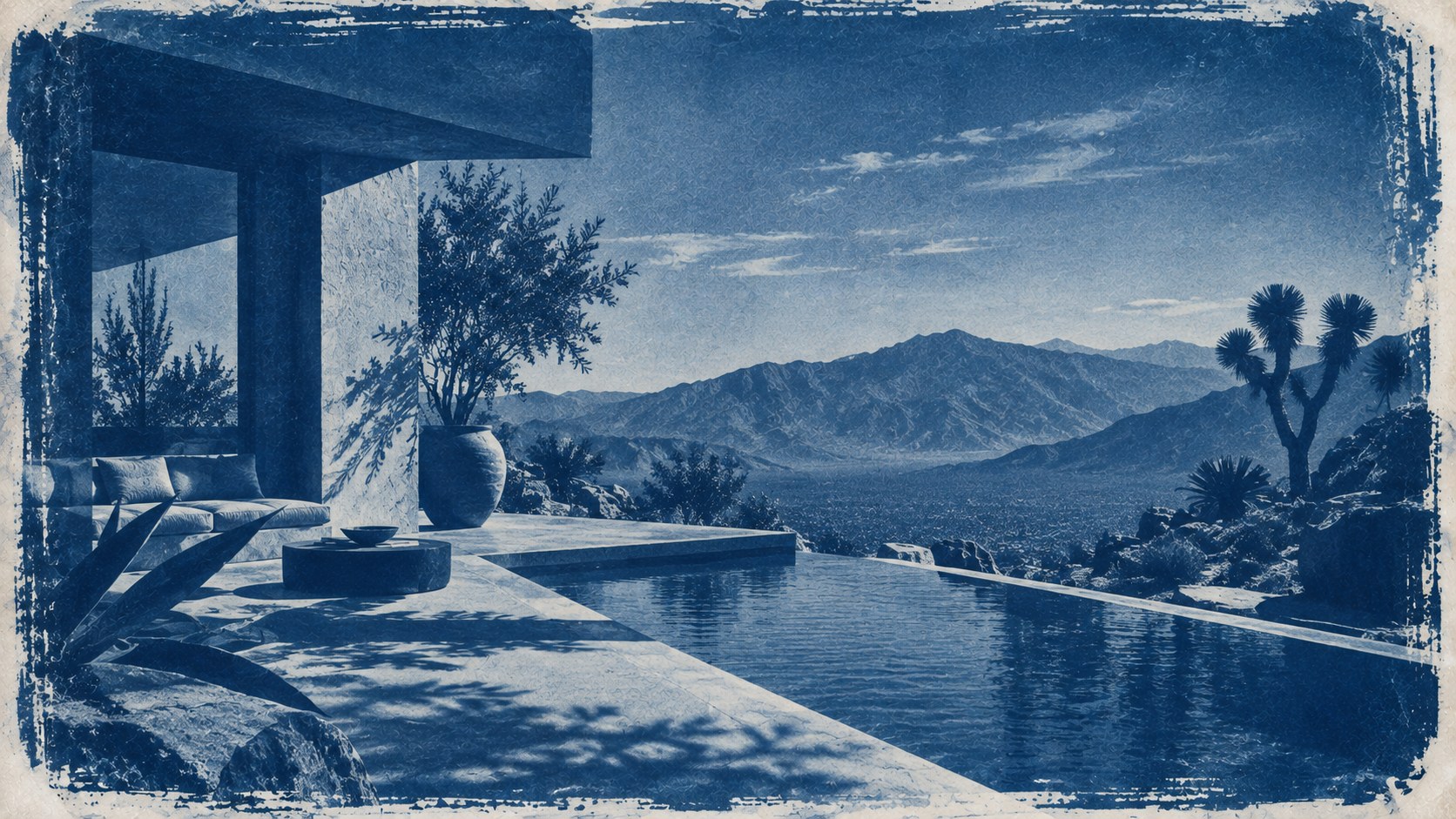
A modern house and infinity pool above a desert valley, printed as a cyanotype in Prussian blue with brushed edges.
Archive plate · Cyanotype Photography
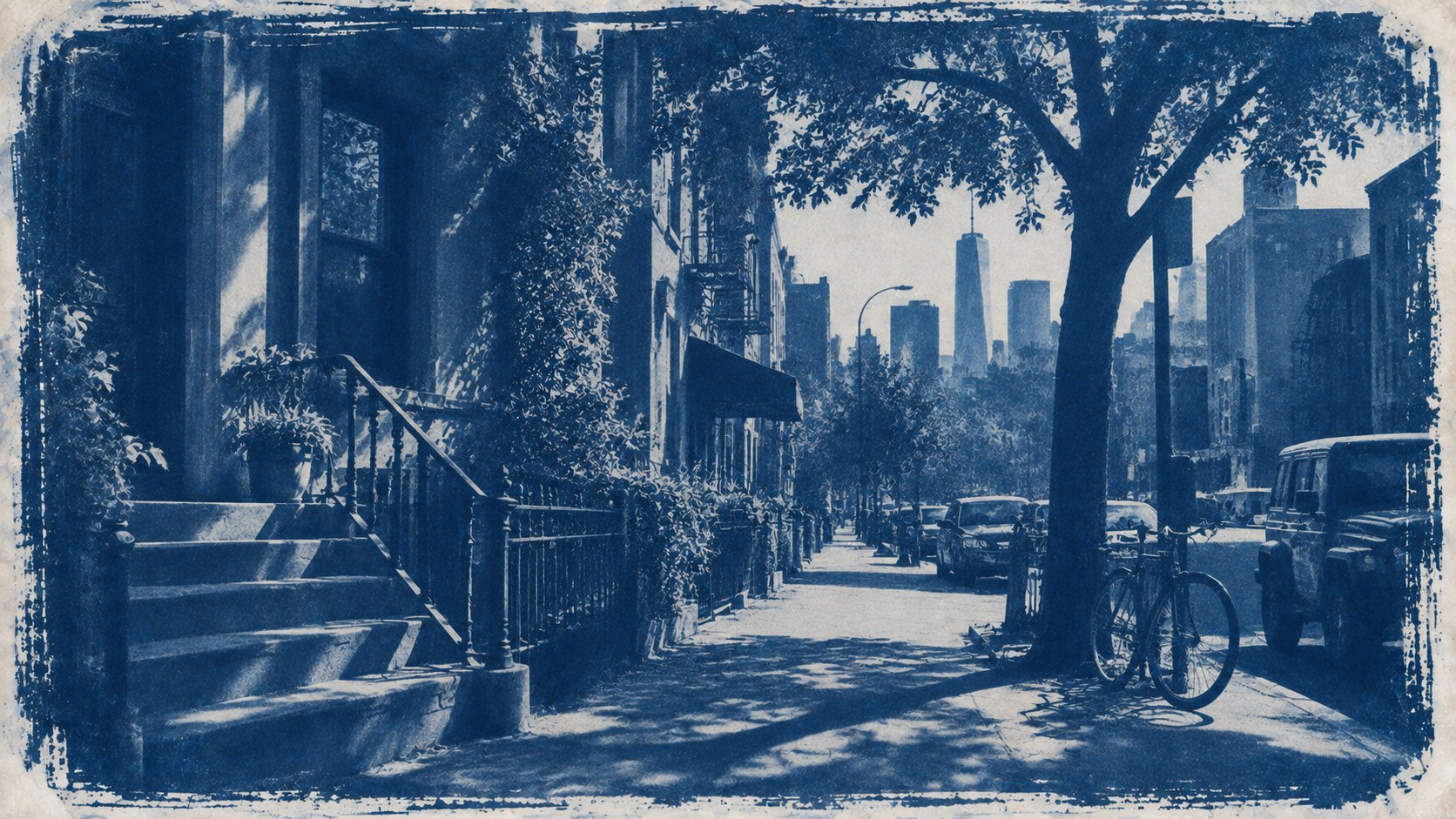
A brownstone street with stoops, trees and a distant skyline, printed as a cyanotype in deep blue and paper white.
Dossier sceneStreet · 1/4
01
The record

What it is, when it works, who it is for, and where it already exists.

How to use it

Record 022-CP - when it works, who it is for, what it looks like

FIELD 01

When to use it

  • Botanical, garden, skincare and apothecary brands with a natural or scientific story
  • Book covers, album sleeves and posters that want a hand-made, archival photograph
  • Textile, stationery and print products where the process can be literal
  • Editorial about plants, oceans, science or memory
FIELD 02

Perfect for

  • Botanical and natural skincare brands
  • Independent publishers and record labels
  • Textile and stationery makers
  • Gardens, herbaria and natural history institutions
FIELD 03

What it looks like

  • Anna Atkins, Photographs of British Algae: Cyanotype Impressions, from 1843
  • Robert Rauschenberg and Susan Weil, blueprint photograms, around 1950
  • Christian Marclay, cyanotypes of unspooled cassette tape, 2008
  • Meghann Riepenhoff, Littoral Drift, prints developed in the surf, from 2014

In the wild, Cyanotype Photography aesthetic real-world examples

Where this aesthetic shows up in the real world · ↗ opens the source site

Omoro Style GuideEvery aesthetic, every field on this page, in one PDF.
Get the guide →
02
The anatomy

Where Cyanotype Photography came from, what makes it recognisable, and the fingerprint it leaves.

History, Cyanotype Photography aesthetic history

1842 to now · John Herschel's iron-salt process in England, carried into science by Anna Atkins and into engineering by the blueprint

The astronomer John Herschel published the cyanotype in 1842, one of several processes he worked out while experimenting with light-sensitive iron salts. Paper brushed with ferric ammonium citrate and potassium ferricyanide turns Prussian blue wherever ultraviolet light reaches it; rinsed in water, whatever was shaded stays white. No camera is needed. Anything laid on the paper in sunlight prints as its own white silhouette, and a negative pressed against it prints as a photograph.

Anna Atkins, a botanist who knew Herschel, saw what it could do for science. From 1843 she laid dried algae directly on sensitised paper and issued the results in parts as Photographs of British Algae: Cyanotype Impressions, generally regarded as the first book illustrated with photographs. Engineers took the same chemistry in another direction. From the 1870s architects and shipyards copied their drawings on cyanotype paper, which is why a technical drawing became a blueprint, until diazo and then photocopying replaced it in the twentieth century.

Artists came back to it because it is the most direct photograph there is. Robert Rauschenberg and Susan Weil made life-size blueprint photograms of bodies around 1950; Christian Marclay has printed unspooled cassette tape; Meghann Riepenhoff leaves sheets in the surf and lets the waves develop them. The current revival runs through botanical prints, textiles, publishing and a very large amateur community, because the kit is cheap, the light source is the sun and every print is slightly out of its maker's control.

Iron salts, sunlight and water: everything the subject covered stays white, everything else turns Prussian blue.

Omoro dossier · 022-CP

Visual markers, Cyanotype Photography aesthetic visual markers

The visual DNA: what makes it recognisable

typography

See the fonts
  • A classic serif or a typewriter face set small on the paper margin, never on the print
  • Pencilled specimen captions, Latin names and dates, as on a herbarium sheet
  • Type in deep blue or black on paper white, so the print keeps the only colour

grid

  • The print shown on its sheet with the brushed edge visible, never cropped tight to the image
  • Specimen layouts: one subject centred with generous paper around it
  • Series set in a strict grid, like the plates of a botanical book
  • Long horizontal or life-size vertical sheets for grasses, fabric and figures

materials

  • Prussian blue #0B2545 and cyan print #1E4D8C for the exposed ground
  • Mid exposure #5F8FC4 and bleached highlight #C9D9E8 for the tones in between
  • Rag paper #F3EEE3 at the brushed edge and wherever the subject lay
  • Cotton rag or watercolour paper, a glass contact frame, sunlight, water, and tea for toning

motifs

  • Ferns, algae, seed heads and grasses as white silhouettes
  • Lace, feathers and sheer fabric printed as white lattices
  • Bodies and hands as pale ghosts with a soft halo where they lifted
  • Brushed emulsion edges, uneven coating and water marks from the wash
  • Tea-toned variants in brown or violet

Aesthetic profile

8-channel console with the fingerprint on its display. Save the card, or share the page

Aesthetic Profile
Cyanotype Photography
1842 to now · John Herschel's iron-salt process in England, carried into science by Anna Atkins and into engineering by the blueprint
Attribute console · 022-CP
leans analog, cool, nostalgic
8 CH
FIG. 1
MinimalMaximalAnalogDigitalRestrainedExpressiveCoolWarmNostalgicFuturisticChaoticStructuredDarkLightOrganicGeometric
01Minimal
Maximal40%
02Analog
Digital100%
03Restrained
Expressive20%
04Cool
Warm90%
05Futuristic
Nostalgic80%
06Structured
Chaotic10%
07Dark
Light10%
08Organic
Geometric80%
AnalogCoolNostalgic
Omoro · Attribute console · 022-CP
omoro.io/styles/cyanotype-photography

Color Palettes, Cyanotype Photography color palettes and hex codes

2 color interpretations of this aesthetic

Cyanotype Photography
#0B2545 · #1E4D8C · #5F8FC4 · #C9D9E8 · #F3EEE3
A fern laid on rag paper in the sun: Prussian blue ground, white silhouette, the brushed edge left in
Cyanotype
#081828 · #1848A0 · #4880D0 · #90C0E8 · #E8F4FF
Blueprint chemistry: Anna Atkins in Prussian blue
Omoro Palette Pack575 curated palettes across every aesthetic, 5 export formats.
Get the palettes →

Adjacent Palettes, styles related to Cyanotype Photography

The colour of the styles sitting closest to this one

Photography
Analog Photography
Blueprint
Printmaking
03
The direction

How to shoot it, how to prompt it, and how to board it.

Photo Direction

How to shoot this aesthetic

"Print with sunlight and iron salts, and let everything the subject didn't cover turn Prussian blue"

Shot list

  • A modern house and pool above a desert valley, contact-printed from a large negative: shade under the overhang in deep blue, the pool and sky pale, the mountains fading into the paper, the brushed coating ragged at every edge
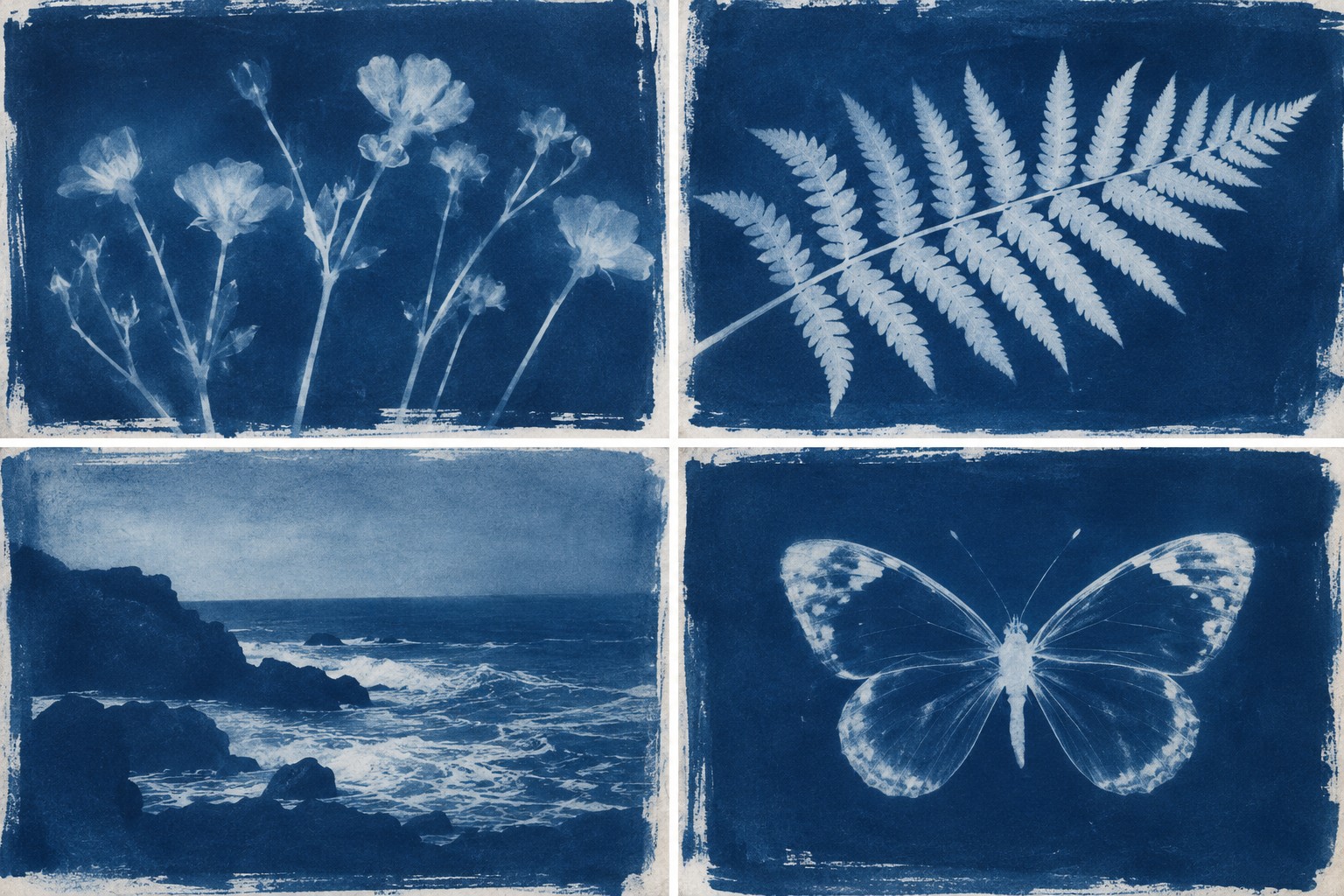
  • Botanical photogram of a single fern frond laid flat on cotton rag paper, the frond a crisp white silhouette on deep Prussian blue, brushed emulsion edges visible at the margins
  • Wildflowers laid loose across the sheet, petals printed as soft white shapes with a little translucency, stems crossing, the arrangement slightly off centre

Lighting

Direct sunlight or a UV exposure unit, and exposures measured in minutes, not fractions of a second. Midday sun gives the deepest blue; cloud stretches the exposure and softens the edges. Contact matters more than light: glass pressed flat gives crisp silhouettes, anything that lifts goes soft.

Omoro Director's Briefs189 photo shot-lists like this one, ready to shoot from.
Get the briefs →

Generative Prompt

Drop this into Studio to generate in this aesthetic

Cyanotype photographic print, Prussian blue iron-salt process on cotton rag paper, white silhouettes and highlights where the paper stayed unexposed, deep blue shadows, soft contact-print detail, visible brushed emulsion edges and uneven hand coating, faint water marks, paper fibre texture, botanical specimens, ferns, algae, lace or figures as photograms or a contact-printed photograph, monochrome blue only, no other colours, no text, no digital gradients, no glossy finish

Paste as-is, or append your own subject

Mood Board

The record applied to your project. The record's kit is free; your brand, references and plates come with membership

Mood board
The Cyanotype Photography board
8 frames · 4 selected
FIG. 4
Prussian Blue0B2545Cyan Print1E4D8CMid Exposure5F8FC4Bleached HighlightC9D9E8Rag PaperF3EEE3
Brand and references
IdleBrand and references open with membership
With membership: the brand's own facts and colours in every prompt, references carried into every frame, and the plates generated.
01 · Hero application
02 · Material and finish
03 · Palette in context
04 · Photography direction
05 · Pattern plate
06 · Object
07 · Environment
08 · Digital presence
Demo kit free, the rest with membershipThe record as a demo kit, free. Name a project and it is written for that
Omoro · Mood board · 022-CP
04
The judgement

Whether to use it, what it costs to do properly, and where it stands right now.

Creative verdict, Cyanotype Photography feasibility and strategic recommendation

Two written calls, seven meters, and when to walk away

Creative verdict
Should Cyanotype Photography be the call?
7 meters
FIG. 2
Assessment

Print it for real. Coat the paper by hand, expose in sunlight and keep the brushed edge, because the edge and the uneven coating are what separate a cyanotype from a blue filter. Choose subjects by their outline: ferns, lace, hands, algae. One colour only, Prussian blue on paper white, and no digital gradient laid over the top.

Verdict

Right when the brand has something natural, scientific or hand-made to show and can live with one colour: botanical skincare, gardens and herbaria, independent publishing, textiles, ocean and climate stories. Its appeal is that the process shows in the result. Print it for real, keep the brushed edges, and never let it become a blue filter.

Production cost
Low

A sensitiser kit, rag paper, a sheet of glass and a sunny day. It is one of the cheapest photographic processes there is.

Creative difficulty
Medium

The process supplies the look; choosing subjects with a strong outline or real transparency is the design decision.

Execution difficulty
Medium

Coating, exposure and washing are easy to learn and hard to repeat exactly; every print comes out slightly different.

Risk of misuse
Medium

A blue duotone on a digital photograph is the common imitation, and anyone who has made a print can tell.

Prevalence
Emerging

A large workshop and craft revival that is starting to appear in botanical, skincare and publishing identities.

Longevity
Timeless

More than 180 years old and still made with the same chemistry, the same paper and the same sun.

Brand investment
Low

A kit, paper and sunlight produce a whole series; scanning the prints well is the only real cost.

Avoid if
The product has to be shown in its true colour
Cyanotype has one colour. Anything whose colour is the point disappears into the blue.
The subject has no clear outline
A photogram prints silhouettes. Dense objects with no shape to them come out as blank white holes.
It will be faked with a blue filter
A duotone on a digital photograph has no brushed edge, no paper grain and no contact-print softness, and it reads as a filter at once.
Omoro · Creative verdict · 022-CP

Editorial Depth

A Pro feature: origins, practitioners, and pitfalls

Editorial depth
The Cyanotype Photography file
14 sections
FIG. 3
Context02Brands02Perception04Use04Index02
01Common MisconceptionThe principle beneath the surface
02Historical ContextOrigins, cultural moment, and reaction
03Brands That Accidentally Use This StyleNatural alignment, not category claims
04Brands That Perfectly Represent This StyleExceptional execution
05Psychological EffectHow visual decisions change perception
06Visual ChecklistInclude and avoid
07Creative FormulaThe visual system reduced to essentials
08Recognition SignalsHow to recognize it in two seconds
09When To Use This StyleContexts where the language performs
10Common Creative MistakesWhere imitation weakens the signal
11Best Brand ApplicationsIndustries with a natural advantage
12Creative Application AnalysisFit, feasibility, and production reality
13Related StylesClose languages and the key distinction
14Visual DNA SummaryThe sentence to remember
The editorial depth, with membershipOpening soon
Omoro · Editorial depth · 022-CP
05
The index

Neighbours, cross-references, blends, and the questions people ask.

Related concepts

Connected across the creative knowledge graph

Cultural relevance, Cyanotype Photography cultural relevance today

Where it stands now, and what it costs you to use it

Cyanotype has become the most visible alternative photographic process of the last decade, carried by workshops, botanical artists and an enormous amateur community. Its appeal is that the process is legible in the result: the sunlight, the chemistry and the hand that coated the paper all show. For brands with a natural, scientific or hand-made story, botanical skincare, gardens, independent publishing and textiles, that legibility does the work of a claim.

The failure mode is the filter. A blue duotone laid over a digital photograph has none of the brushed edge, the paper grain or the soft contact-print detail, and anyone who has made a print sees it at once. The work that lands is actually printed, or at least scanned from a real print, with one colour and the edges left in.

Cross-references

PhotographyThe parent discipline, in the form that does not even need a cameraAnalog PhotographyThe same love of process, grain and the physical printBlueprintThe same iron chemistry, put to work copying engineering drawingsPrintmakingA print made by hand, one sheet at a time, each slightly different

Blend

Mix Cyanotype Photography with any style in the library

Cyanotype Photography×
50%50%
40% alike
Cyanotype Photography referencePhotography referenceCyanotype Photography 50%Photography 50%

Merged palette

#0B2545

#1C1A18

#1E4D8C

#4A4640

#5F8FC4

Leads cool, nostalgic, organic

Typography · from Cyanotype Photography

Zilla Slab over Source Sans 3

Materials

  • Prussian blue #0B2545 and cyan print #1E4D8C for the exposed ground
  • Mid exposure #5F8FC4 and bleached highlight #C9D9E8 for the tones in between
  • Black and white documentary: pure black #0A0A0A through pure white #FAFAFA

The calls this blend forces

These two disagree on 2 things, and a blend cannot average them: you pick a side. At this mix:

Analog or Digital? Cyanotype Photography is analog, Photography is digital. This mix lands analog.

Cool or Warm? Cyanotype Photography is cool, Photography is warm. This mix lands cool.

Use it

Cyanotype photographic print, Prussian blue iron-salt process on cotton rag paper, white silhouettes and highlights where the paper stayed unexposed, deep blue shadows, soft contact-print detail, visible brushed emulsion edges and uneven hand coating, faint water marks, paper fibre texture, botanical specimens, ferns, algae, lace or figures as photograms or a contact-printed photograph, monochrome blue only, no other colours, no text, no digital gradients, no glossy finish (50%), infused with Fine art photography with intentional composition and considered light, full tonal range and sharp technical execution, decisive-moment or carefully staged image-making, gallery-print quality, an authored point of view over snapshot documentation, color palette strictly #0B2545 #1C1A18 #1E4D8C #4A4640 #5F8FC4, leaning analog over digital, cool over warm, overall character: cool, nostalgic, organic

One-click generation opens with the studio

About this aesthetic

What is a cyanotype?

A photographic print made with two iron salts, ferric ammonium citrate and potassium ferricyanide. Paper coated with the mixture turns Prussian blue where ultraviolet light reaches it and stays white where it is shaded, and a rinse in water fixes the image. John Herschel published the process in 1842.

Do you need a camera to make a cyanotype?

No. The simplest cyanotype is a photogram: lay a leaf, a piece of lace or any object on the coated paper, expose it to sunlight and wash it, and the object prints as a white silhouette. To print a photograph, contact-print a negative the size of the finished print, which can be made on a home printer on transparency film.

How is cyanotype related to the blueprint?

They are the same chemistry. From the 1870s architects and engineers copied drawings on cyanotype paper, which is why technical drawings came to be called blueprints and why the Blueprint style in the library shares its colour. The blueprint used the process as a copier; cyanotype photography uses it to make images.

Build with the cyanotype photography aesthetic

Every style in the library is broken down like this one: the palette, the typography, the materials and the lineage.

Explore the style library →