Tension Report - Where They Diverge4 FINDINGS
Δ is the gap between the two on that spectrum, 0 (identical) to 100 (opposite poles).
Analog carries the trace of a hand; digital carries the precision of a system. It is usually the first thing a viewer clocks about how something was made. Parametric Architecture leans digital, Deconstructivism stays closer to analog.
Organic feels grown; geometric feels drawn. It is the difference between a form that occurred and one that was decided. Deconstructivism leans geometric, Parametric Architecture stays closer to organic.
Both point the same way in time. The gap is how far they go. Deconstructivism leans nostalgic, Parametric Architecture stays closer to futuristic.
Both are ordered to a similar degree. What differs is where each allows a little slack. Deconstructivism leans chaotic, Parametric Architecture stays closer to structured.
Both lean into these. Expect less friction here than everywhere the report just flagged.
both lean expressive - they'd argue about everything else ✦
Deconstructivism vs Parametric Architecture: 87% affinity (Highly compatible)
Where they split: Parametric Architecture leans digital, Deconstructivism stays closer to analog. Also diverging: Organic vs Geometric (Δ25), Futuristic vs Nostalgic (Δ20), Structured vs Chaotic (Δ15). Where they agree: both lean expressive, maximal.
Safe to blend: close enough that mixing Deconstructivism and Parametric Architecture reads as one coherent direction, not two competing ones.
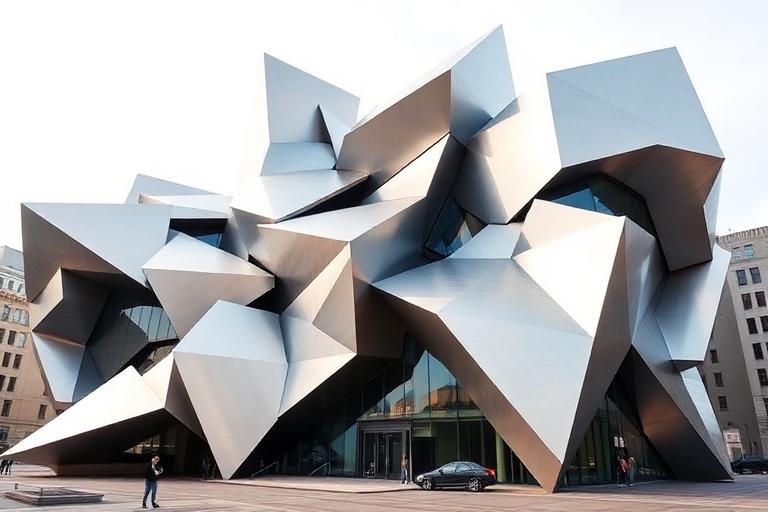
Fragmentation as architecture - Deconstructivism shattered the box into colliding planes, skewed angles, and controlled chaos, rejecting the right angle, from Gehry's titanium folds to Zaha Hadid's flying geometries and Libeskind's fractured voids.
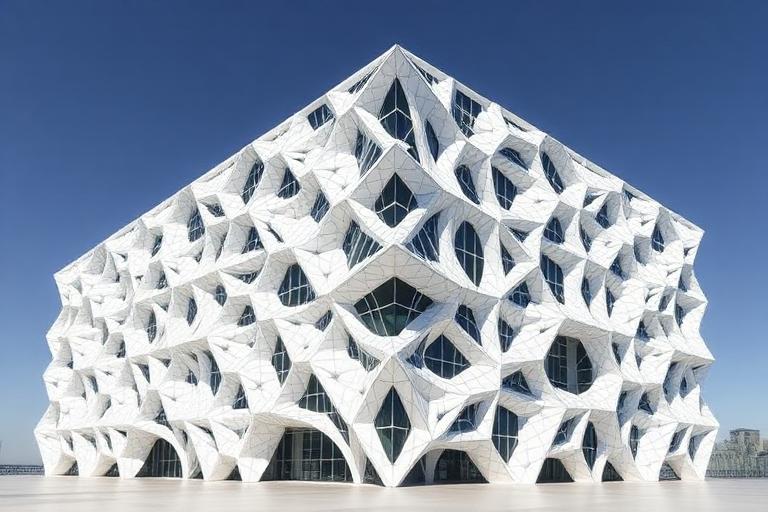
Full style guide →Form generated by algorithm - Parametricism uses computational rules and digital fabrication to produce fluid, continuously differentiated surfaces no hand could draw, where every panel and beam is a variable in a single mathematical system.
Full style guide →