Registrar's index cards on the platen glass - captured by the scanner
2000s-present · Global, with theoretical center at the Architectural Association, London
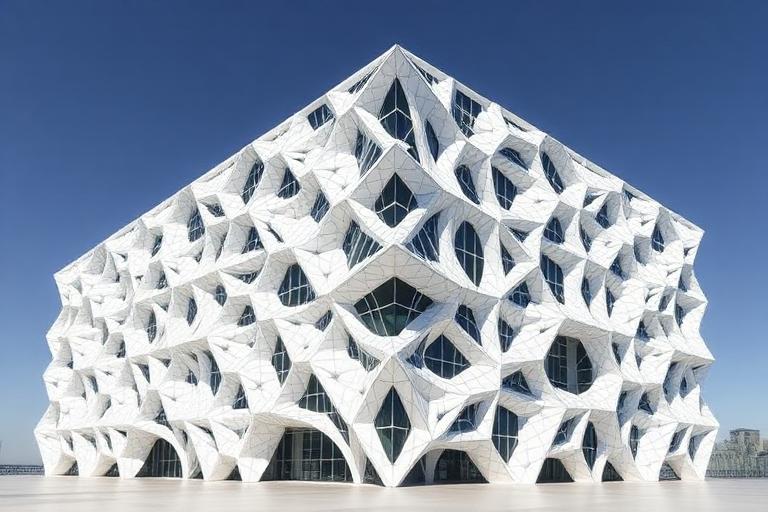
Parametric architecture uses computational algorithms to generate form: instead of drawing a shape, the architect defines relationships, rules, and variables, and the software generates geometry that satisfies all conditions simultaneously. Patrik Schumacher, Zaha Hadid's partner, coined the term 'Parametricism' in 2008 and proposed it as the successor to Modernism, Postmodernism, and Deconstructivism as architecture's next epochal style.
The tools that enable Parametricism (Grasshopper for Rhino, CATIA, generative design algorithms) developed through the 2000s, building on the earlier computational work of architects like Greg Lynn (blob architecture) and the research labs at the Architectural Association's DRL and ETH Zurich. Hadid's buildings (Heydar Aliyev Center in Baku, Guangzhou Opera House, Al Wakrah Stadium in Qatar) demonstrate the aesthetic at its most resolved: fluid, continuous surfaces that flow from ground to wall to roof without seams or corners.
Parametricism has been criticized on multiple fronts: its tendency toward formal spectacle disconnected from program, its dependence on expensive digital fabrication, and Schumacher's claims of stylistic hegemony. But the underlying technology is now integral to architectural practice at all scales. Structural optimization (using algorithms to place material only where forces require it), generative facade design, and computational environmental analysis are standard tools. Parametric thinking has become invisible infrastructure even in buildings that do not look 'parametric.'
The visual DNA: what makes it recognisable
- Contemporary geometric faces: Calibre, Circular, GT Walsheim
- Variable fonts reflecting parametric logic
- Thin weights suggesting computational precision
- Type integrated with algorithmically generated graphics
- Flowing surfaces with no corners or seams
- Voronoi, Delaunay, and other algorithmic surface patterns
- Non-repeating panel geometries derived from computational optimization
- Structural grids generated by force flow analysis
- Glass-reinforced concrete (GRC) in curved panels: #E0E0E0, #D0D0D0
- Aluminum composite panels with unique geometries: #C8CCD0, #B8BCC0
- ETFE cushions and pneumatic membranes: #E8ECF0, #D8DCE0
- 3D-printed or CNC-milled structural elements: variable
- Voronoi and cellular surface patterns
- Doubly curved surfaces impossible to develop flat
- Perforated skins with algorithmically varied apertures
- Continuous surfaces flowing between ground, wall, and roof
8-channel console - dominant channels taped & circled by the registrar
Your aesthetic passport - share the fingerprint
The style's primary materials, assembled bottom-up
Tap a stratum for material detail · Full catalog
Future-Facing · 2000–present - tap any style to travel
Join waitlist for access
Join the waitlist for full access
Join the waitlistParametric Architecture: where the language earns its place
Parametric Architecture is most effective when its visual decisions do useful work. Form generated by algorithm - Parametricism uses computational rules and digital fabrication to produce fluid, continuously differentiated surfaces no hand could draw, where every panel and beam is a variable in a single mathematical system.
The style gives styling, proportion, and image sequencing a clear point of view rather than treating them as decoration.
It can turn atmosphere, material, and spatial pacing into evidence of a distinct experience before a visitor arrives.
It helps a physical or editorial environment feel authored, which raises attention and perceived care.
They recognize the references, proportion, and restraint that make the language feel intentional.
They respond to visible judgment because it reduces the feeling of interchangeable product.
A coherent aesthetic gives them a usable standard for choosing images, objects, and collaborators.
The cost comes from consistent art direction, suitable locations or materials, and time to edit the details that would otherwise undermine the premise.
The challenge is conceptual. It takes visual literacy and a real point of view to avoid borrowing surface cues without their original logic.
Lighting, casting, type, color, material, and retouching must agree. A single weak choice can make the work feel like an imitation.
Parametric Architecture creates its strongest advantage when it gives a brand a standard of judgment, not merely an attractive finish. It fails when recognizable cues are collected without a governing idea. The difference between average and exceptional execution is usually proportion: how much is shown, what is withheld, and whether every element belongs to the same world. The most capable teams pair an exacting art director with specialists who understand the medium, from photographer and stylist to set designer, editor, and typographer.
Should Parametric Architecture be the strategic choice?
Surface imitation is easy. The language becomes generic when familiar cues replace proportion, specificity, and a coherent system.
Its visual ingredients appear regularly in contemporary work, but a rigorous execution remains distinguishable from a loose collection of references.
Its strongest principles depend on composition, material, and cultural literacy rather than a short-lived visual effect.
It asks for consistency across photography, typography, motion, environments, and the many details that make a brand feel believable.
Parametric Architecture deserves serious consideration from brands and institutions that can articulate a real point of view and protect it through execution. It is less suitable for work that needs immediate instructional clarity, broad visual neutrality, or low-cost production flexibility. Its greatest advantage is differentiation through judgment: it can make a product, place, or editorial proposition feel authored rather than merely packaged. Average executions borrow recognizable signals, then lose coherence when type, casting, copy, or materials fail to agree. Exceptional executions understand the visual language as a system of choices, including what not to show. The largest mistake is treating the style as a finish applied after strategy. Adopt it only when the product and organization can carry the same standard of care the imagery proposes.
Join waitlist for access
Join the waitlist for editorial depth
Join the waitlistConnected across the creative knowledge graph