Conceptual Sketch

The drawing made before the thing exists: construction lines, blue pencil, marker and handwritten notes on tracing paper

Compare Conceptual Sketch with another style →See the Conceptual Sketch typefaces →
Record022-CS
AestheticConceptual Sketch
ClassAnalog / Light
StatusINGESTING
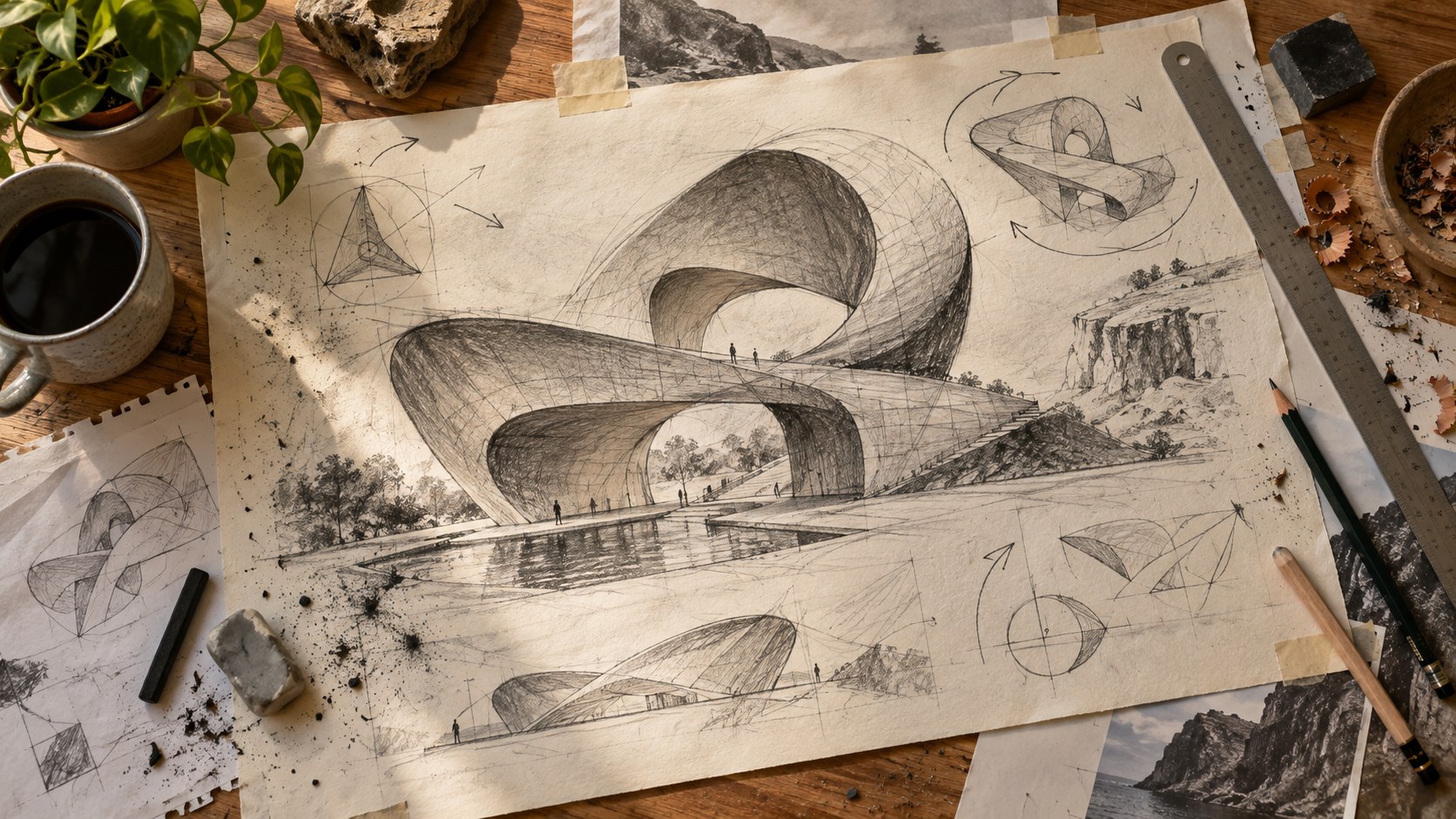
A loose pencil drawing of a sweeping curved building on taped tracing paper, with thumbnails, a steel rule, pencils and coffee around it.
Archive plate · Conceptual Sketch
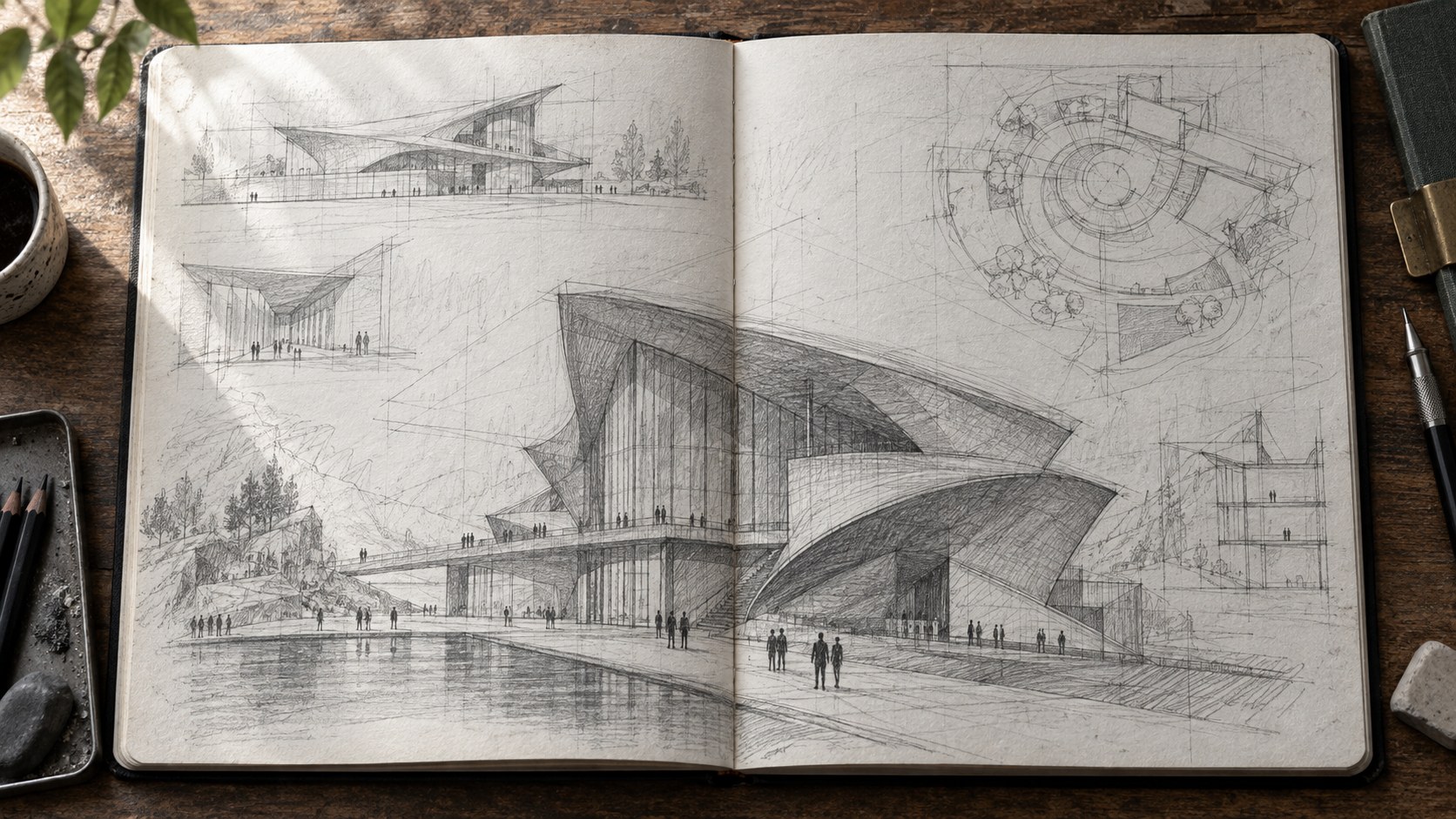
An open sketchbook with a pencil perspective of an angular waterfront building, a plan and elevations on the facing page.
Dossier sceneNotebook · 1/5
01
The record

What it is, when it works, who it is for, and where it already exists.

How to use it

Record 022-CS - when it works, who it is for, what it looks like

FIELD 01

When to use it

  • Showing a product, building or idea while it is still being decided
  • Pitch decks and case studies that need to show the thinking
  • Brands that want to look like makers rather than marketers
  • Explainers where a diagram is friendlier than a render
FIELD 02

Perfect for

  • Industrial and product design studios
  • Architects and interior designers
  • Film, game and automotive concept teams
  • Startups showing a product before it ships
FIELD 03

What it looks like

  • Leonardo da Vinci's notebooks, where drawing is how the thinking happens, c. 1480 to 1519
  • Erich Mendelsohn's thumbnail sketches for the Einstein Tower, 1917 to 1920
  • Jørn Utzon's competition sketches for the Sydney Opera House, 1957
  • Ralph McQuarrie's concept paintings for Star Wars, 1975

In the wild, Conceptual Sketch aesthetic real-world examples

Where this aesthetic shows up in the real world · ↗ opens the source site

Omoro Style GuideEvery aesthetic, every field on this page, in one PDF.
Get the guide →
02
The anatomy

Where Conceptual Sketch came from, what makes it recognisable, and the fingerprint it leaves.

History, Conceptual Sketch aesthetic history

c. 1480 to now; the marker-and-tracing-paper form from the 1950s · Renaissance workshop drawing, formalised by architects, industrial designers and film art departments

Leonardo da Vinci's notebooks are the founding documents. Across thousands of pages, from about 1480 until his death in 1519, he used drawing to work things out: flying machines, river systems, the muscles of a shoulder. The sheets are crowded, annotated in mirror script and full of second attempts. They were never meant as finished art, and that is exactly what later centuries admired in them: the drawing as an instrument of thought.

Architects made the quick sketch a professional habit. Erich Mendelsohn drew the first ideas for the Einstein Tower as tiny ink thumbnails while serving on the front in the First World War, and the built tower of 1921 still looks like one of them. In 1957 Jørn Utzon won the Sydney Opera House competition with drawings so loose that, by a story often repeated, the judge Eero Saarinen had to pull them back out of the rejected pile. The lesson stuck: a sketch can carry an idea that a finished drawing would bury.

The modern look came from industrial design studios after 1945. Car stylists in Detroit and product designers everywhere settled on a shared kit: layout paper, blue pencil, markers and chalk, with perspective drawn fast and shaded faster. Film borrowed it. When George Lucas needed to sell Star Wars to a studio in 1975 he commissioned paintings from Ralph McQuarrie, a former Boeing technical illustrator, and Syd Mead brought the same industrial hand to Blade Runner. Concept art has been a genre of its own ever since, and its conventions, the construction lines, the notes, the variations on a sheet, are now a style that brands borrow.

The drawing made before the thing exists, with the thinking left in.

Omoro dossier · 022-CS

Visual markers, Conceptual Sketch aesthetic visual markers

The visual DNA: what makes it recognisable

typography

See the fonts
  • Handwritten capitals in the designer's own hand
  • Arrows, leader lines and short callouts
  • Dimensions and material notes beside the detail they describe
  • A date, a project name or a title block in one corner

grid

  • Several variations on one sheet, numbered or lettered
  • A large hero view with thumbnails around it
  • Overlaid tracing paper showing earlier versions
  • Drawings running off the edge of the sheet

materials

  • Tracing paper #EFEBDD and graphite #3A3A3C
  • Col-Erase blue #2B4C8C for the underdrawing
  • Cool grey marker #A9B0B5 for form, marker orange #E8762B for emphasis
  • Layout pads, fineliners, ballpoint, masking tape

motifs

  • Construction lines and ellipses drawn through the form
  • A circled option and a crossed-out one
  • Marker streaks and bleed past the outline
  • Coffee rings, tape and smudges left in

Aesthetic profile

8-channel console with the fingerprint on its display. Save the card, or share the page

Aesthetic Profile
Conceptual Sketch
c. 1480 to now; the marker-and-tracing-paper form from the 1950s · Renaissance workshop drawing, formalised by architects, industrial designers and film art departments
Attribute console · 022-CS
leans analog, light, expressive
8 CH
FIG. 1
MinimalMaximalAnalogDigitalExpressiveRestrainedWarmCoolFuturisticNostalgicChaoticStructuredLightDarkGeometricOrganic
01Minimal
Maximal30%
02Analog
Digital80%
03Restrained
Expressive50%
04Cool
WarmEVEN
05Futuristic
Nostalgic10%
06Structured
Chaotic40%
07Dark
Light60%
08Organic
Geometric20%
AnalogLightExpressive
Omoro · Attribute console · 022-CS
omoro.io/styles/conceptual-sketch

Color Palettes, Conceptual Sketch color palettes and hex codes

The definitive color scheme for this aesthetic

Conceptual Sketch
#EFEBDD · #3A3A3C · #2B4C8C · #E8762B · #A9B0B5
A designer's desk at midnight: tracing paper, graphite and blue pencil, one orange marker for the part that matters
Omoro Palette Pack575 curated palettes across every aesthetic, 5 export formats.
Get the palettes →

Adjacent Palettes, styles related to Conceptual Sketch

The colour of the styles sitting closest to this one

Drawing / Sketch
Blueprint
Hand-drawn Doodles
Tech Spec
03
The direction

How to shoot it, how to prompt it, and how to board it.

Photo Direction

How to shoot this aesthetic

"Photograph the drawing as an object, on the desk where it was made"

Shot list

  • A sheet of thumbnails flat from above, pencils and markers at the edge of frame
  • A hand mid-line, the pencil moving, the sheet taped to the board
  • Tracing paper lifted to show the earlier version underneath

Lighting

Soft daylight from the side, or a single desk lamp. Raking light shows the tooth of the paper, the dent of the pencil and the sheen of marker, which is what makes it read as an object rather than a scan.

Omoro Director's Briefs224 photo shot-lists like this one, ready to shoot from.
Get the briefs →

Generative Prompt

Drop this into Studio to generate in this aesthetic

Conceptual sketch, a loose design drawing of a product or building made before it exists, confident freehand line with visible construction lines and ellipses drawn through the form, blue Col-Erase pencil underdrawing, graphite and fineliner over it, cool grey alcohol marker shading with streaks and bleed, one accent in orange marker, handwritten notes, arrows and dimensions in capital letters, drawn on tracing paper taped to a board with an earlier version showing through, slightly smudged, several numbered variations on one sheet, no photographic render, no clean vector lines

Paste as-is, or append your own subject

Mood Board

The record applied to your project. The record's kit is free; your brand, references and plates come with membership

Mood board
The Conceptual Sketch board
8 frames · 4 selected
FIG. 4
Tracing PaperEFEBDDGraphite3A3A3CCol-Erase Blue2B4C8CMarker OrangeE8762BCool Grey MarkerA9B0B5
Brand and references
IdleBrand and references open with membership
With membership: the brand's own facts and colours in every prompt, references carried into every frame, and the plates generated.
01 · Hero application
02 · Material and finish
03 · Palette in context
04 · Photography direction
05 · Pattern plate
06 · Object
07 · Environment
08 · Digital presence
Demo kit free, the rest with membershipThe record as a demo kit, free. Name a project and it is written for that
Omoro · Mood board · 022-CS
04
The judgement

Whether to use it, what it costs to do properly, and where it stands right now.

Creative verdict, Conceptual Sketch feasibility and strategic recommendation

Two written calls, seven meters, and when to walk away

Creative verdict
Should Conceptual Sketch be the call?
7 meters
FIG. 2
Assessment

Hire a hand. A real sketch has wrong lines in it, and those searching strokes are the evidence of thinking that the style trades on. Draw through the form, keep the construction lines, and add notes only where they explain a decision. A render run through a sketch filter is the one thing to avoid: every line has the same weight and the whole drawing goes dead.

Verdict

Right when the thinking is the product: studios, consultancies, launches and anything still being shaped. It earns trust by showing the wrong turns, and it fails the moment the sketch is drawn after the fact to decorate a finished thing.

Production cost
Low

Paper, pencils and markers. The cost is someone who can actually draw.

Creative difficulty
Medium

The sketch has to contain a real idea; loose lines around nothing fool nobody.

Execution difficulty
High

Confident line and correct perspective take years, and a hesitant sketch is worse than none.

Risk of misuse
Medium

Used as decoration, with fake notes and filtered photos, it reads as a brand pretending to have a process.

Prevalence
Common

Design studios, car makers and film art departments have shown their sketches for decades.

Longevity
Timeless

People have drawn ideas before building them for as long as there has been paper.

Brand investment
Low

One good illustrator and a scanner. The work scales with how many ideas need drawing.

Avoid if
The product is finished and needs to look finished
A sketch says provisional. At the shelf or the checkout it reads as not ready.
Nobody on the team can draw
Filtered photos and traced renders have even line weight and no searching strokes, and it shows.
The audience needs precise information
A sketch communicates intent, not dimensions. Use a drawing or a spec for that.
Omoro · Creative verdict · 022-CS

Editorial Depth

A Pro feature: origins, practitioners, and pitfalls

Editorial depth
The Conceptual Sketch file
14 sections
FIG. 3
Context02Brands02Perception04Use04Index02
01Common MisconceptionThe principle beneath the surface
02Historical ContextOrigins, cultural moment, and reaction
03Brands That Accidentally Use This StyleNatural alignment, not category claims
04Brands That Perfectly Represent This StyleExceptional execution
05Psychological EffectHow visual decisions change perception
06Visual ChecklistInclude and avoid
07Creative FormulaThe visual system reduced to essentials
08Recognition SignalsHow to recognize it in two seconds
09When To Use This StyleContexts where the language performs
10Common Creative MistakesWhere imitation weakens the signal
11Best Brand ApplicationsIndustries with a natural advantage
12Creative Application AnalysisFit, feasibility, and production reality
13Related StylesClose languages and the key distinction
14Visual DNA SummaryThe sentence to remember
The editorial depth, with membershipOpening soon
Omoro · Editorial depth · 022-CS
05
The index

Neighbours, cross-references, blends, and the questions people ask.

Related concepts

Connected across the creative knowledge graph

Cultural relevance, Conceptual Sketch cultural relevance today

Where it stands now, and what it costs you to use it

A sketch is persuasive because it is unfinished. It invites the viewer into the decision rather than presenting a verdict, which is why studios put sketches in case studies and car makers release them before a launch. In a period when a photoreal image of anything can be generated in seconds, a drawing with wrong lines in it has become a kind of proof that a person was thinking.

Its failure mode is the filter. A render or a photograph pushed through a sketch effect has uniform line weight, no construction and no hesitation. Real sketches vary their pressure, draw through the form and show the first guess under the second. The mistakes are the signature.

Cross-references

Drawing / SketchThe parent discipline; this is drawing with a job to doBlueprintWhat the sketch becomes once the decision is madeHand-drawn DoodlesShares the hand, without the engineeringTech SpecThe measured, finished end of the same process

Blend

Mix Conceptual Sketch with any style in the library

Conceptual Sketch×
50%50%
86% alike
Conceptual Sketch referenceDrawing / Sketch referenceConceptual Sketch 50%Drawing / Sketch 50%

Merged palette

#EFEBDD

#1C1C1C

#3A3A3C

#3A3A3A

#2B4C8C

Leads analog, expressive, light

Typography · from Conceptual Sketch

Caveat over Lora

Materials

  • Tracing paper #EFEBDD and graphite #3A3A3C
  • Col-Erase blue #2B4C8C for the underdrawing
  • Graphite grey: #B0A898, #A09888: the tone of pencil on white paper

Use it

Conceptual sketch, a loose design drawing of a product or building made before it exists, confident freehand line with visible construction lines and ellipses drawn through the form, blue Col-Erase pencil underdrawing, graphite and fineliner over it, cool grey alcohol marker shading with streaks and bleed, one accent in orange marker, handwritten notes, arrows and dimensions in capital letters, drawn on tracing paper taped to a board with an earlier version showing through, slightly smudged, several numbered variations on one sheet, no photographic render, no clean vector lines (50%), infused with Fine art drawing with expressive graphite or charcoal linework, visible construction lines and cross-hatching for shading, sketchbook immediacy and gestural confidence, tonal range from paper-white to deep charcoal, hand-drawn observational-study quality, color palette strictly #EFEBDD #1C1C1C #3A3A3C #3A3A3A #2B4C8C, overall character: analog, expressive, light

One-click generation opens with the studio

About this aesthetic

What is a conceptual sketch?

A loose drawing made to explore or communicate an idea before it is built: a product, a building, a character, a scene. It keeps its construction lines, notes and variations visible, because its job is to show thinking, not a finish.

How is it different from technical drawing or a blueprint?

A technical drawing is measured and final, made so something can be manufactured. A conceptual sketch comes first. It is fast, approximate and open to change, and it communicates intent rather than dimensions.

What tools define the look?

Tracing or layout paper, a blue or graphite pencil for the underdrawing, fineliner or ballpoint for the line, and alcohol markers in cool greys for shading, with one bright marker for emphasis. Handwritten notes and arrows finish it.

Can I fake it digitally?

You can draw it digitally with a tablet and it will hold up, because the hand is still real. What does not hold up is a photo or render run through a sketch filter: the line weight is uniform and there is no construction underneath.

Build with the conceptual sketch aesthetic

Every style in the library is broken down like this one: the palette, the typography, the materials and the lineage.

Explore the style library →