Registrar's index cards on the platen glass - captured by the scanner
1980s–1990s (architectural material); 2019–present (aesthetic revival) · Architecture and interior design; 1980s commercial interiors; design revival communities
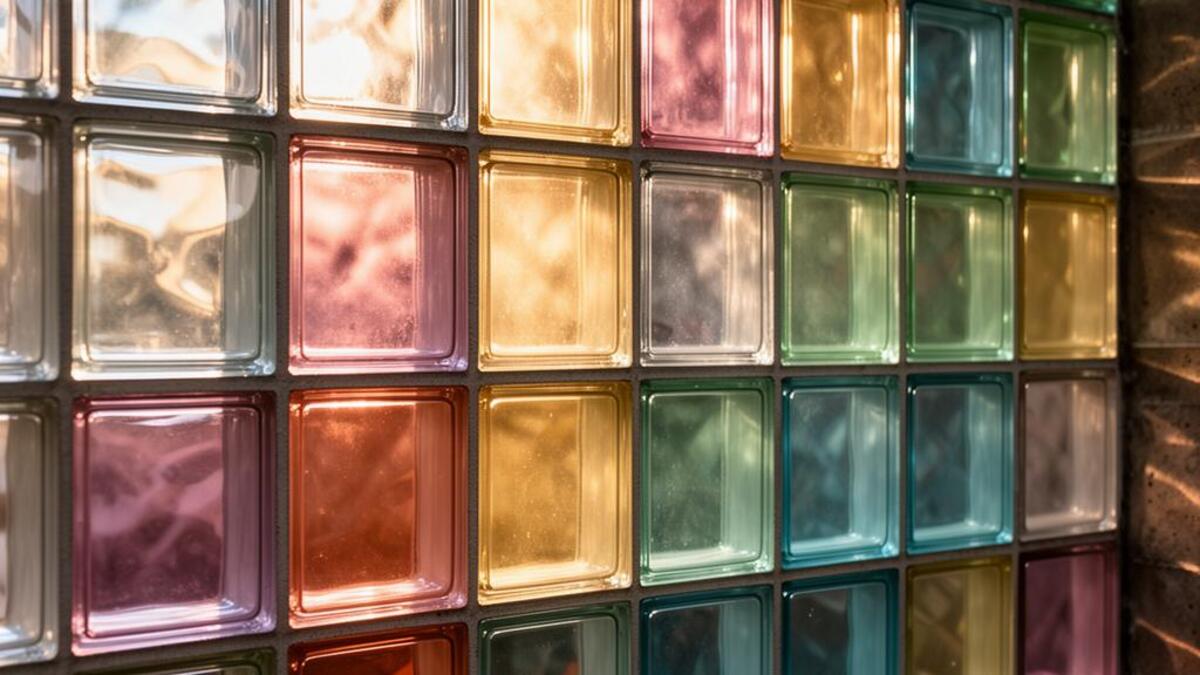
Glass blocks (or glass bricks) are a construction material developed in the 1930s and popularized in 1970s–1990s architecture: thick glass units that transmit light while obscuring detail, used in bathroom walls, exterior windows, and commercial interiors. Their distinctive visual quality: the soft, distorted transmission of light and color through an opaque medium: became culturally associated with the era of their peak use.
The glass block aesthetic revival in design began around 2019, initially in fashion photography (shooting through glass blocks to create distorted, dreamlike portraits) and digital art (simulating the material's frosted-glass distortion in Photoshop and After Effects). The aesthetic connects to a broader nostalgia for 1980s–1990s material culture that also produced the terrazzo revival, the brutalism appreciation, and the return of brass fixtures.
In contemporary design, the glass block aesthetic appears as: photography effects (shooting through or compositing glass block material), digital UI elements that reference the material's translucency, illustration that simulates the look, and actual architectural revival in high-end hospitality and residential projects. It occupies a specific register: nostalgic but sophisticated, warm but obscuring.
The visual DNA: what makes it recognisable
- Type seen through glass distortion: letterforms blurred and color-shifted
- Frosted text: white type at reduced opacity suggesting glass surface
- Clean sans-serif set over glass-block photography
- Type that sits on or within the glass surface rather than floating above it
- The glass grid itself as composition: the regular pattern of block segments
- Portrait photographs seen through glass block: figure distorted into color fields
- Horizontal light bands as compositional elements (light entering from outside)
- Tiled pattern repeat using the square glass block module
- Frosted white: #E8EAEC, #D8DCE0: the semi-opaque glass surface color
- Diffused blue: #A8B8C8, #90A8BC: light passing through glass acquires this quality
- Warm amber: #E8D0A8: warm interior light seen through the material
- Structural grey: #787880: the mortar or frame color surrounding glass blocks
- The regular grid of glass block segments as texture and pattern
- Distorted human figures: recognizable but obscured by glass
- Light bands and caustic patterns from light transmission
- Frosted opacity with color and form barely visible beneath
8-channel console - dominant channels taped & circled by the registrar
Your aesthetic passport - share the fingerprint
4 color interpretations of this aesthetic
How to shoot this aesthetic
Join waitlist for access
Join the waitlist for full access
Join the waitlistGlass Block: where the language earns its place
Glass Block is most effective when its visual decisions do useful work. 80s architectural glass with prismatic light and transparent building blocks
The style gives styling, proportion, and image sequencing a clear point of view rather than treating them as decoration.
It can turn atmosphere, material, and spatial pacing into evidence of a distinct experience before a visitor arrives.
It helps a physical or editorial environment feel authored, which raises attention and perceived care.
They recognize the references, proportion, and restraint that make the language feel intentional.
They respond to visible judgment because it reduces the feeling of interchangeable product.
A coherent aesthetic gives them a usable standard for choosing images, objects, and collaborators.
The cost comes from consistent art direction, suitable locations or materials, and time to edit the details that would otherwise undermine the premise.
The challenge is conceptual. It takes visual literacy and a real point of view to avoid borrowing surface cues without their original logic.
Lighting, casting, type, color, material, and retouching must agree. A single weak choice can make the work feel like an imitation.
Glass Block creates its strongest advantage when it gives a brand a standard of judgment, not merely an attractive finish. It fails when recognizable cues are collected without a governing idea. The difference between average and exceptional execution is usually proportion: how much is shown, what is withheld, and whether every element belongs to the same world. The most capable teams pair an exacting art director with specialists who understand the medium, from photographer and stylist to set designer, editor, and typographer.
Should Glass Block be the strategic choice?
Surface imitation is easy. The language becomes generic when familiar cues replace proportion, specificity, and a coherent system.
Its visual ingredients appear regularly in contemporary work, but a rigorous execution remains distinguishable from a loose collection of references.
Its strongest principles depend on composition, material, and cultural literacy rather than a short-lived visual effect.
It asks for consistency across photography, typography, motion, environments, and the many details that make a brand feel believable.
Glass Block deserves serious consideration from brands and institutions that can articulate a real point of view and protect it through execution. It is less suitable for work that needs immediate instructional clarity, broad visual neutrality, or low-cost production flexibility. Its greatest advantage is differentiation through judgment: it can make a product, place, or editorial proposition feel authored rather than merely packaged. Average executions borrow recognizable signals, then lose coherence when type, casting, copy, or materials fail to agree. Exceptional executions understand the visual language as a system of choices, including what not to show. The largest mistake is treating the style as a finish applied after strategy. Adopt it only when the product and organization can carry the same standard of care the imagery proposes.
Join waitlist for access
Join the waitlist for editorial depth
Join the waitlistConnected across the creative knowledge graph