Precisionism

Industrial America drawn clean: factories, grain elevators and water towers reduced to flat planes, hard edges and long shadows, with no people and no smoke

Compare Precisionism with another style →See the Precisionism typefaces →
Record035-PR
AestheticPrecisionism
ClassStructured / Geometric
StatusINGESTING
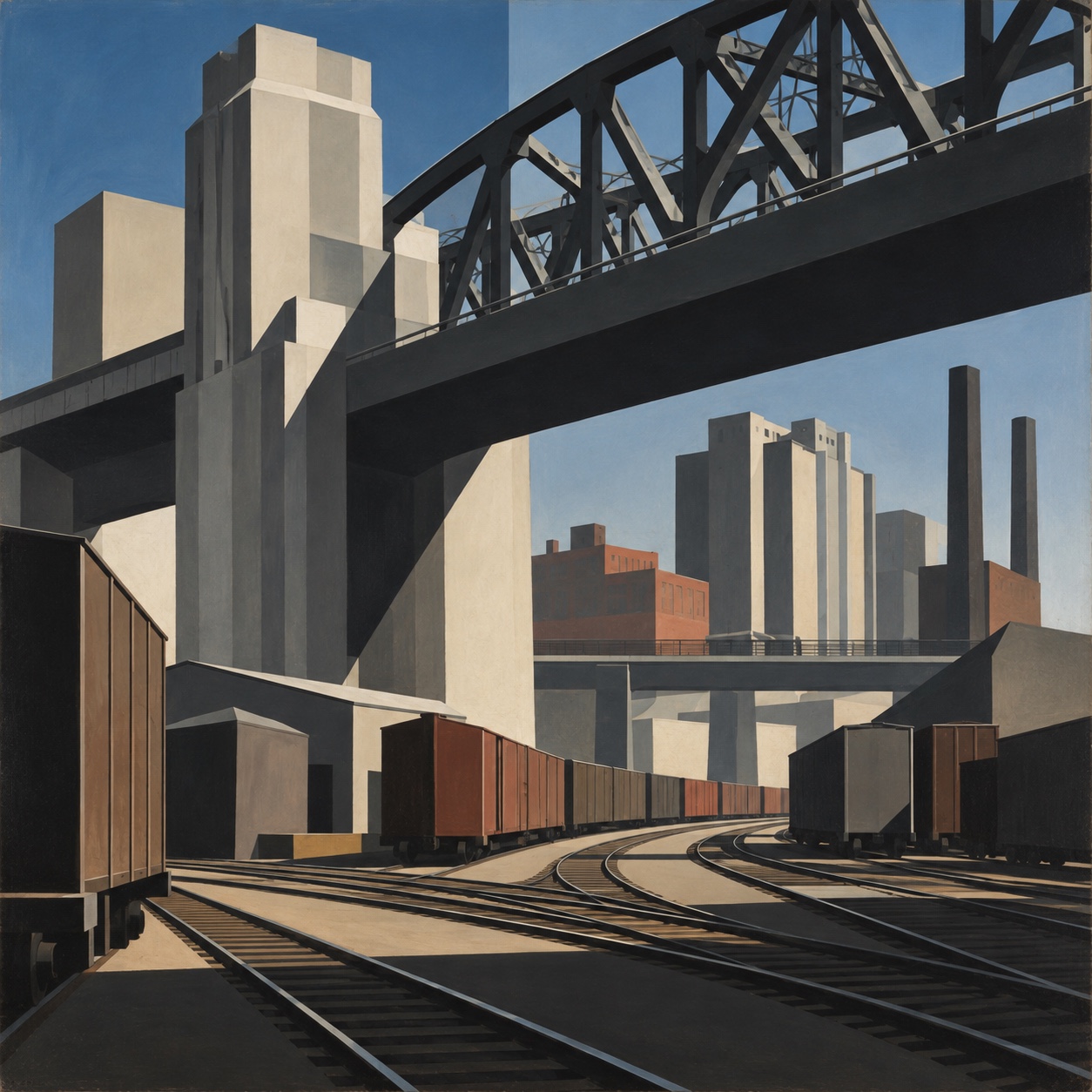
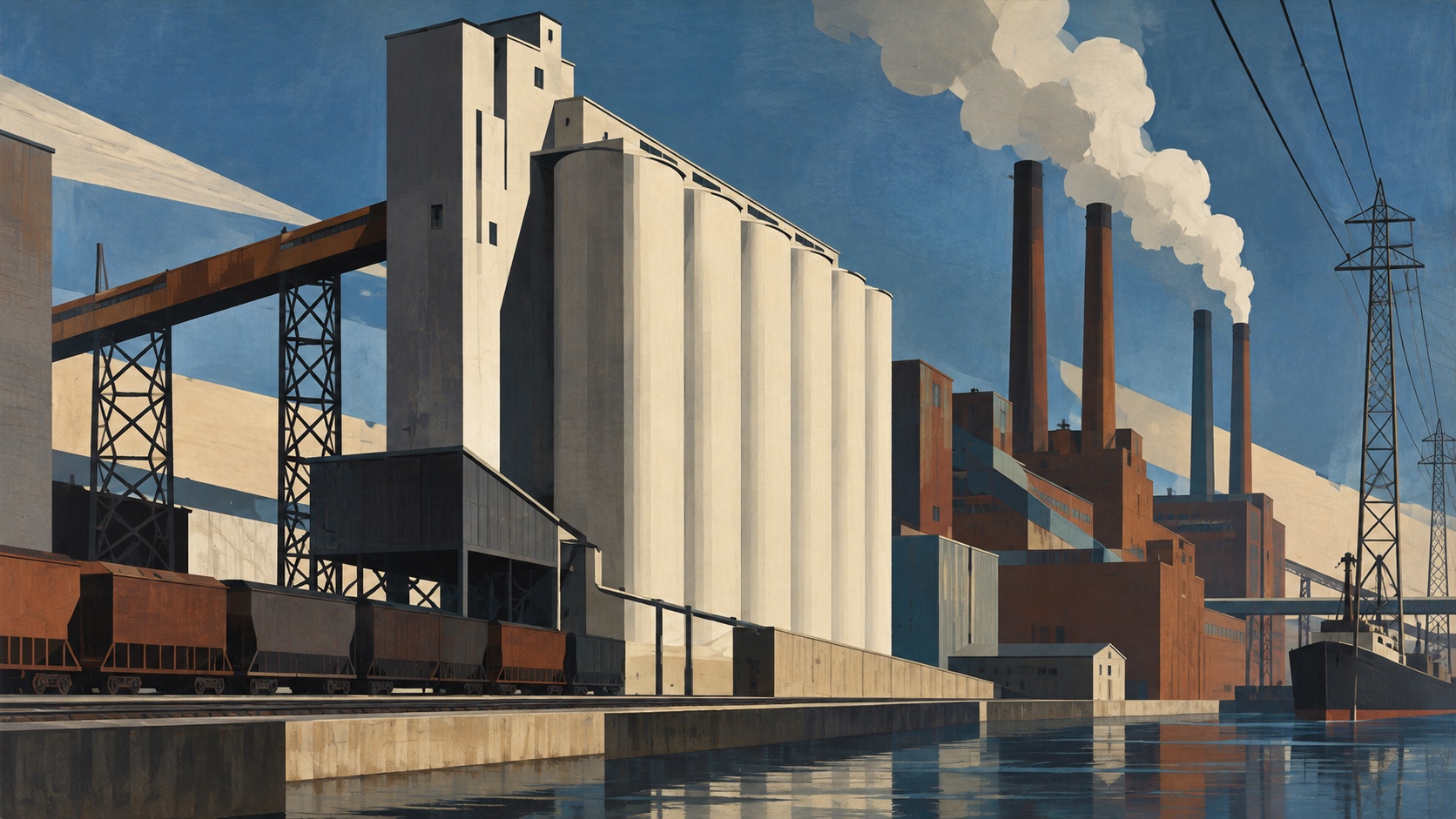
A factory of white silos, sheds and smokestacks beside water, drawn in flat planes under a blue sky.
Archive plate · Precisionism
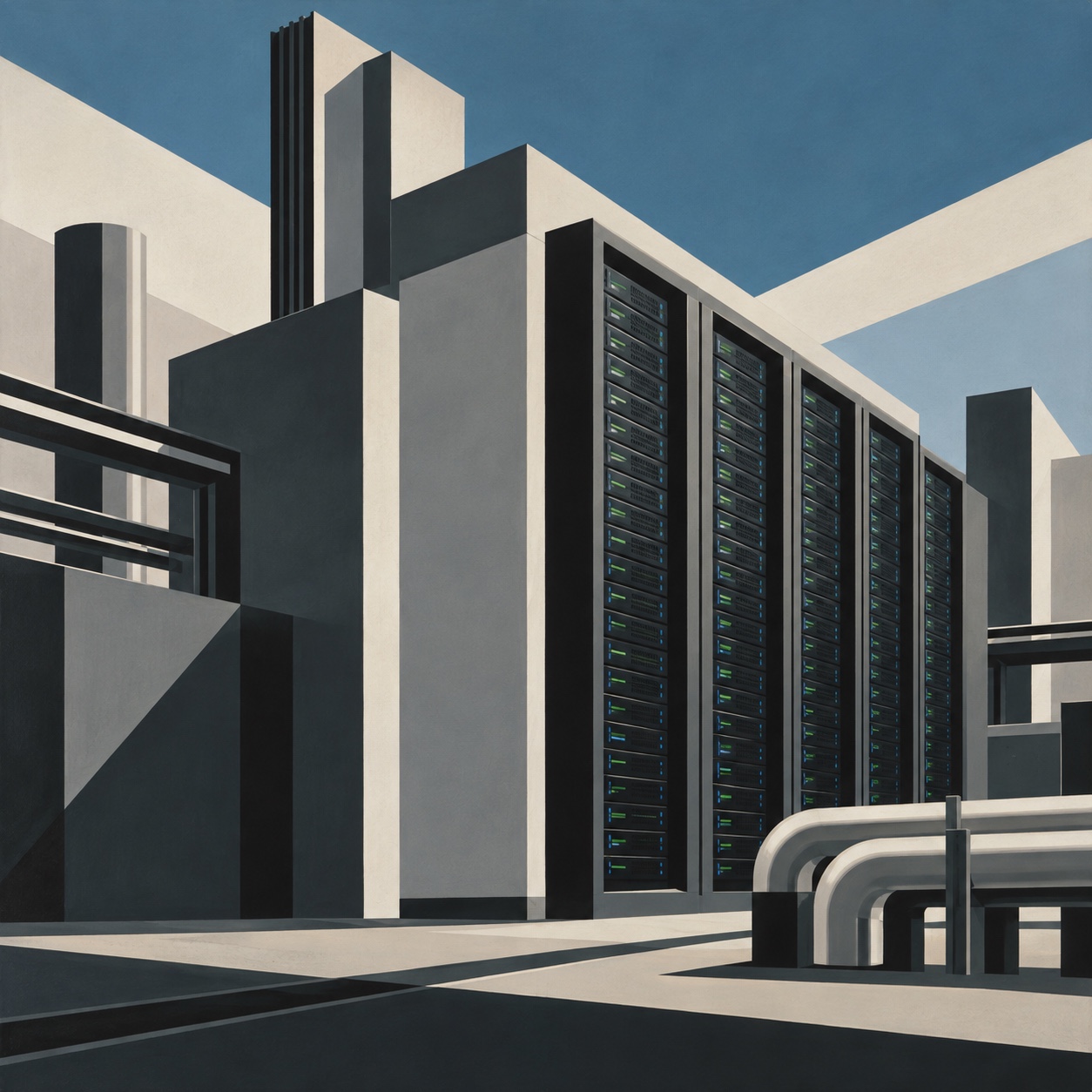
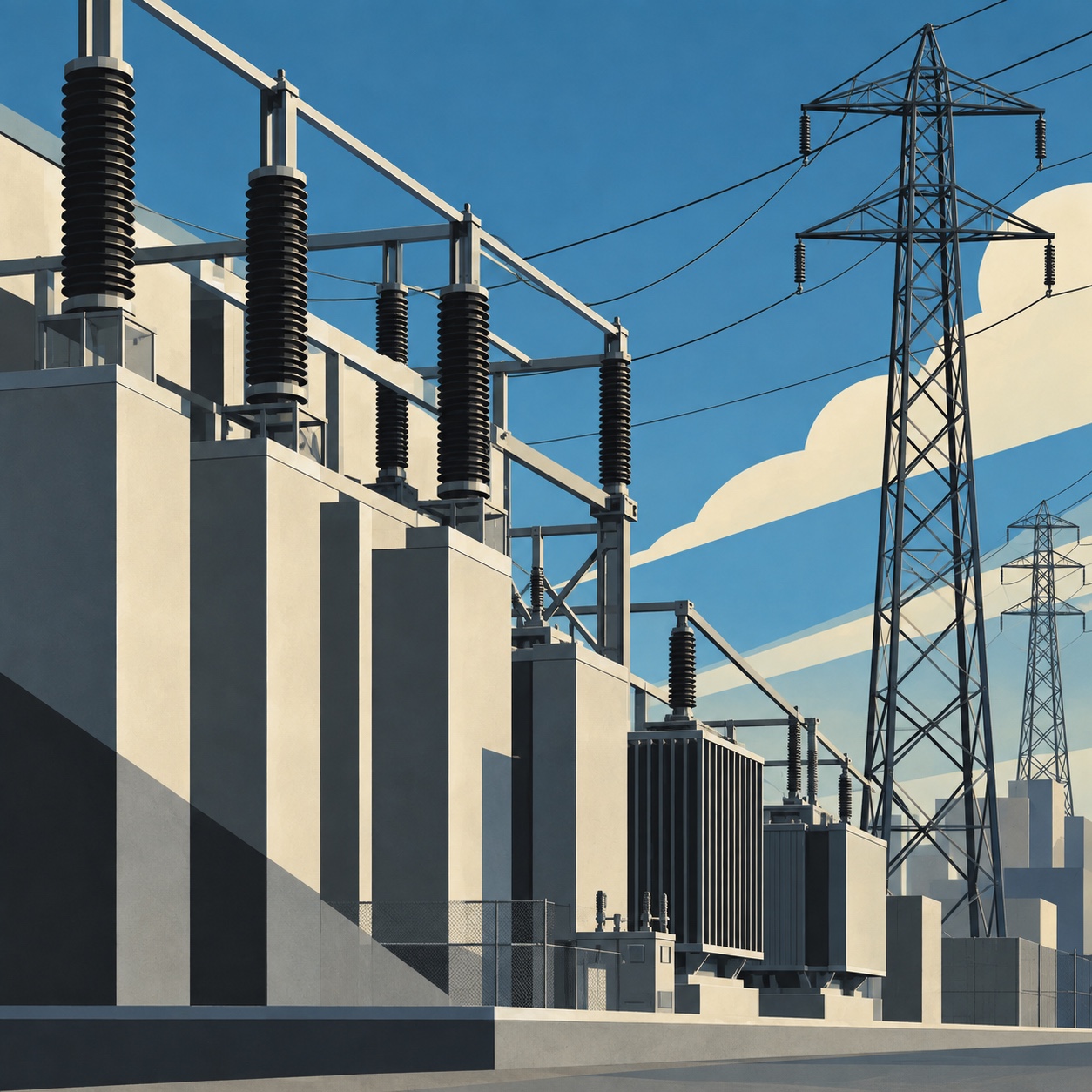
A factory of flat grey planes, smokestacks and pipes under a blue sky, drawn with hard edges and long shadows.
Dossier sceneFactory · 1/5
01
The record

What it is, when it works, who it is for, and where it already exists.

How to use it

Record 035-PR - when it works, who it is for, what it looks like

FIELD 01

When to use it

  • Infrastructure, energy and logistics brands that want to look built
  • Technology and manufacturing companies explaining what they make
  • Editorial illustration for business, cities and industry
  • Annual reports, murals and campaigns about work and scale
FIELD 02

Perfect for

  • Energy, infrastructure and logistics companies
  • Manufacturing and hardware brands
  • Business and city magazines
  • Architecture and engineering practices
FIELD 03

What it looks like

  • Charles Demuth, My Egypt, 1927, a Lancaster grain elevator as a monument
  • Charles Sheeler's River Rouge photographs for Ford, 1927, published in Vanity Fair in 1928
  • Sheeler's American Landscape, 1930, and Classic Landscape, 1931
  • Alfred H. Barr Jr. giving the movement its name, 1927

In the wild, Precisionism aesthetic real-world examples

Where this aesthetic shows up in the real world · ↗ opens the source site

Omoro Style GuideEvery aesthetic, every field on this page, in one PDF.
Get the guide →
02
The anatomy

Where Precisionism came from, what makes it recognisable, and the fingerprint it leaves.

History, Precisionism aesthetic history

1920s-1930s · American painting between the wars: Sheeler, Demuth and the River Rouge plant

Precisionism was America's first modernism of its own. In the 1920s a group of painters, Charles Sheeler and Charles Demuth chief among them, took the flattened planes of European Cubism and Futurism and turned them on American subjects: grain elevators, factories, water towers, bridges and barns, drawn with hard edges, smooth surfaces and long shadows, with no people in sight. Alfred H. Barr Jr., soon to found the Museum of Modern Art, gave the tendency its name in 1927.

The same year produced its two monuments. Demuth's My Egypt painted a grain elevator in his home town of Lancaster, Pennsylvania, as if it were a pyramid, and Sheeler, hired through the advertising agency N. W. Ayer to photograph Ford's new River Rouge plant near Detroit, spent six weeks there and made photographs that ran in Ford News, Vanity Fair and the avant-garde magazines. From them came his paintings American Landscape in 1930 and Classic Landscape in 1931, the factory as a calm, classical order.

It faded with the Depression and the war, but its way of seeing did not. The clean, unpeopled, geometric rendering of infrastructure is the default of energy, logistics and technology illustration, of the flat-shaded architectural scene and the isometric explainer. The current version keeps the stillness and the pride, and finds new subjects: data centres, wind farms, ports and grids.

Industry drawn clean, still and proud, with the people left out.

Omoro dossier · 035-PR

Visual markers, Precisionism aesthetic visual markers

The visual DNA: what makes it recognisable

typography

See the fonts
  • Geometric sans in small capitals, set flat and quiet
  • Stencilled numerals as on a silo or a tank
  • Engineering labels and plate numbers
  • No expressive type; the structure carries the composition

grid

  • Strong verticals and horizontals from the buildings themselves
  • One diagonal of shadow or conveyor cutting the frame
  • Low horizons and empty foregrounds
  • Planes stacked in receding layers

materials

  • Steel blue #2E4D6B, concrete grey #D1D0CF and brick #C76F45 as the planes
  • Yard sand #BDB396 and shadow #38383B as light and dark
  • Oil, photography, flat digital illustration, concrete, steel and glass

motifs

  • Grain elevators, silos and water towers
  • Factory sheds, conveyors and smokestacks without smoke
  • Long hard shadows across blank walls
  • Ladders, pipes and railings as line work

Aesthetic profile

8-channel console with the fingerprint on its display. Save the card, or share the page

Aesthetic Profile
Precisionism
1920s-1930s · American painting between the wars: Sheeler, Demuth and the River Rouge plant
Attribute console · 035-PR
leans structured, geometric, restrained
8 CH
FIG. 1
MinimalMaximalDigitalAnalogRestrainedExpressiveCoolWarmNostalgicFuturisticStructuredChaoticLightDarkGeometricOrganic
01Minimal
Maximal40%
02Analog
DigitalEVEN
03Restrained
Expressive60%
04Cool
Warm50%
05Futuristic
Nostalgic50%
06Structured
Chaotic90%
07Dark
Light30%
08Organic
Geometric90%
StructuredGeometricRestrained
Omoro · Attribute console · 035-PR
omoro.io/styles/precisionism

Color Palettes, Precisionism color palettes and hex codes

The definitive color scheme for this aesthetic

Precisionism
#2E4D6B · #D1D0CF · #C76F45 · #BDB396 · #38383B
A factory at noon: steel blue, concrete grey and brick red under a sky white, with one navy shadow
Omoro Palette Pack575 curated palettes across every aesthetic, 5 export formats.
Get the palettes →

Adjacent Palettes, styles related to Precisionism

The colour of the styles sitting closest to this one

Cubism
Industrial Architecture
Photorealism
3D Vector Illustration
03
The direction

How to shoot it, how to prompt it, and how to board it.

Photo Direction

How to shoot this aesthetic

"Photograph industry as monument: hard noon light, no people, planes and one long shadow"

Shot list

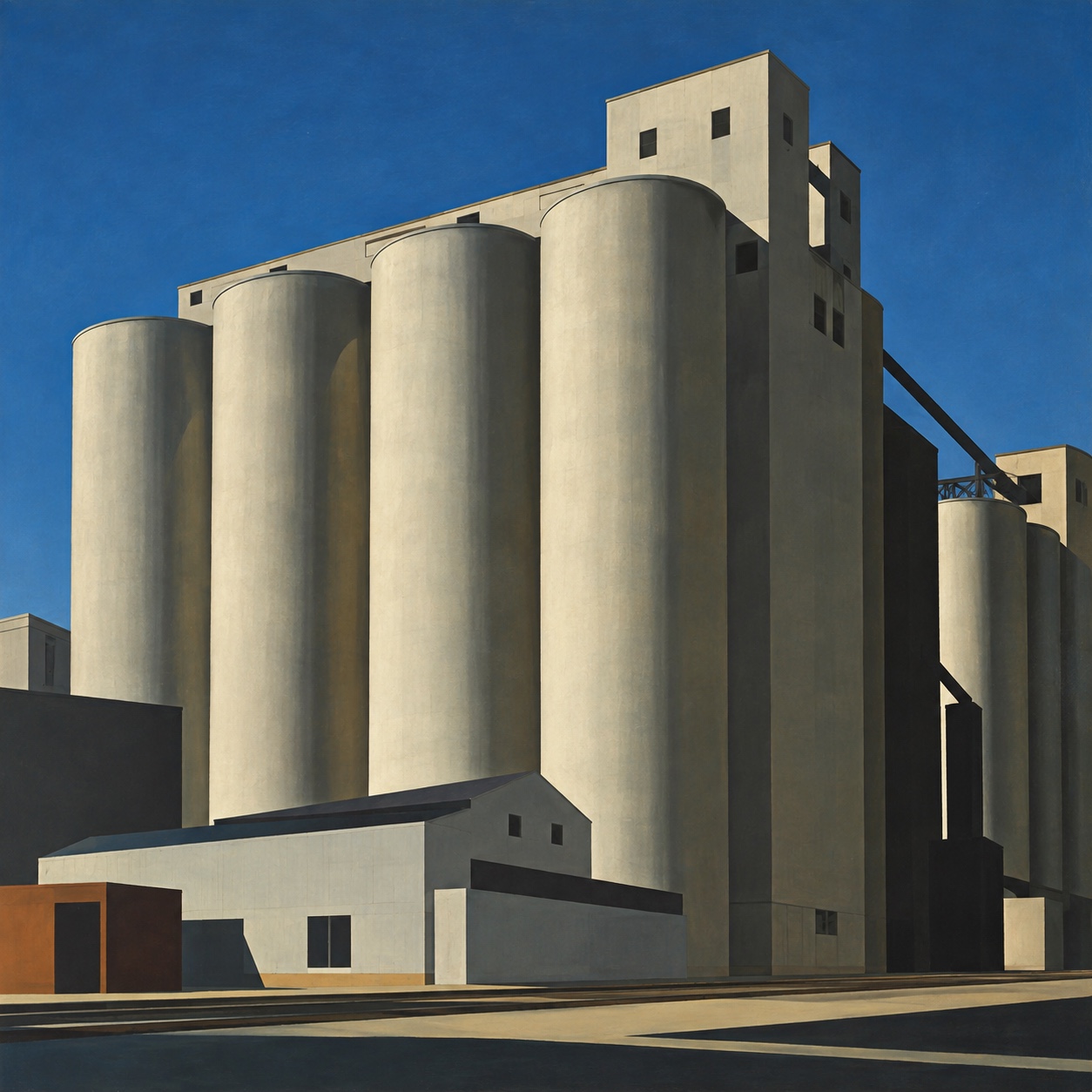
  • A grain elevator or silo against a clear sky, shot square, one shadow across its face
  • A factory shed with conveyors crossing the frame diagonally, no workers
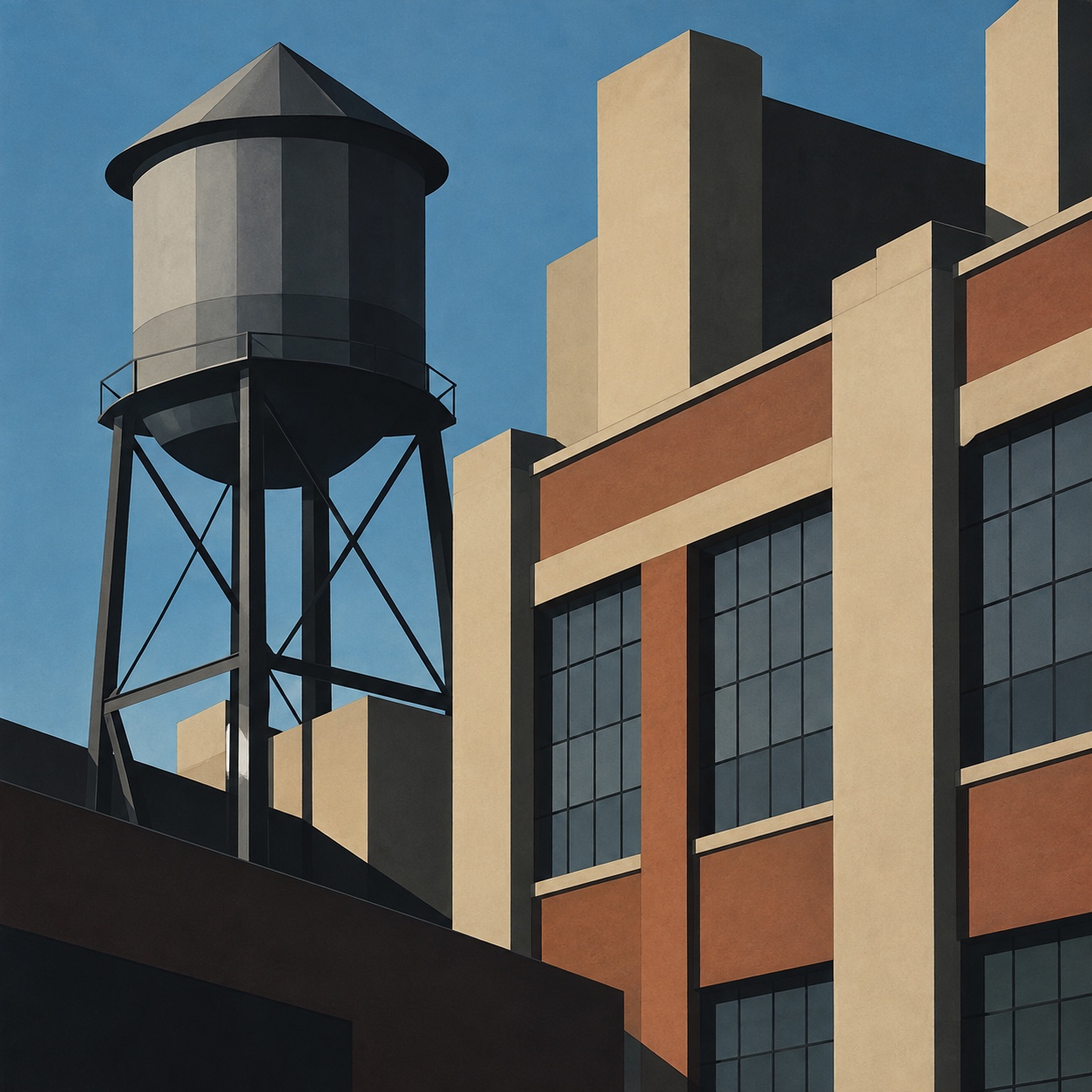
  • A water tower on its legs against a white sky, low horizon

Lighting

Hard noon sun or a hard key light, so every plane is either lit or in one clean shadow. Clear sky, no haze, no clouds if possible; colour graded toward steel, concrete and brick with a white sky.

Omoro Director's Briefs212 photo shot-lists like this one, ready to shoot from.
Get the briefs →

Generative Prompt

Drop this into Studio to generate in this aesthetic

Precisionism aesthetic, 1920s American painting of industry, a grain elevator, factory or water tower reduced to flat planes with hard edges and smooth surfaces, long diagonal shadow, clear white sky, steel blue, concrete grey and brick red, no people, no smoke, still and monumental, clean geometric composition, no readable text

Paste as-is, or append your own subject

Mood Board

The record applied to your project. The record's kit is free; your brand, references and plates come with membership

Mood board
The Precisionism board
8 frames · 4 selected
FIG. 4
Steel Blue2E4D6BConcrete GreyD1D0CFBrickC76F45Yard SandBDB396Shadow38383B
Brand and references
IdleBrand and references open with membership
With membership: the brand's own facts and colours in every prompt, references carried into every frame, and the plates generated.
01 · Hero application
02 · Material and finish
03 · Palette in context
04 · Photography direction
05 · Pattern plate
06 · Object
07 · Environment
08 · Digital presence
Demo kit free, the rest with membershipThe record as a demo kit, free. Name a project and it is written for that
Omoro · Mood board · 035-PR
04
The judgement

Whether to use it, what it costs to do properly, and where it stands right now.

Creative verdict, Precisionism feasibility and strategic recommendation

Two written calls, seven meters, and when to walk away

Creative verdict
Should Precisionism be the call?
7 meters
FIG. 2
Assessment

Start from a real building and reduce it to planes with one hard light and one long shadow. Keep the palette to steel, concrete, brick and sky, set type small and flat, and leave out people and smoke. A generic factory in flat blue with no light is clip art.

Verdict

Right when the brand builds or runs things at scale and wants that to look calm and ordered: energy, infrastructure, logistics, manufacturing and hardware. It rewards a real subject and a real light, and fails as a stock factory.

Production cost
Low

An illustrator with a ruler, or a photographer with hard light; no expensive materials.

Creative difficulty
Medium

The rules are strict; choosing the structure and the one shadow is the design.

Execution difficulty
Medium

Flat planes have to be drawn exactly, and the light has to be consistent across every surface.

Risk of misuse
Medium

It sits next to stock isometric illustration and can read as generic without a specific subject.

Prevalence
Common

Energy, logistics and technology illustration uses its geometry as a default.

Longevity
Enduring

A century old, and the way industry has been pictured with pride ever since.

Brand investment
Low

One illustration system covers reports, campaigns and murals.

Avoid if
The brand is about people, warmth or community
The style removes people on purpose; it is monumental, not human.
There is no real structure to draw
Without a specific building it becomes generic isometric illustration.
The subject needs motion or energy
Precisionism is still by design; speed belongs to Futurism.
Omoro · Creative verdict · 035-PR

Editorial Depth

A Pro feature: origins, practitioners, and pitfalls

Editorial depth
The Precisionism file
14 sections
FIG. 3
Context02Brands02Perception04Use04Index02
01Common MisconceptionThe principle beneath the surface
02Historical ContextOrigins, cultural moment, and reaction
03Brands That Accidentally Use This StyleNatural alignment, not category claims
04Brands That Perfectly Represent This StyleExceptional execution
05Psychological EffectHow visual decisions change perception
06Visual ChecklistInclude and avoid
07Creative FormulaThe visual system reduced to essentials
08Recognition SignalsHow to recognize it in two seconds
09When To Use This StyleContexts where the language performs
10Common Creative MistakesWhere imitation weakens the signal
11Best Brand ApplicationsIndustries with a natural advantage
12Creative Application AnalysisFit, feasibility, and production reality
13Related StylesClose languages and the key distinction
14Visual DNA SummaryThe sentence to remember
The editorial depth, with membershipOpening soon
Omoro · Editorial depth · 035-PR
05
The index

Neighbours, cross-references, blends, and the questions people ask.

Related concepts

Connected across the creative knowledge graph

Cultural relevance, Precisionism cultural relevance today

Where it stands now, and what it costs you to use it

Precisionism is the look of industry presented with pride: clean, still and unpeopled. Energy, logistics, manufacturing and technology brands use its geometry to make infrastructure look ordered and calm, and editorial illustration uses it for anything built at scale.

Its failure mode is the stock isometric. A generic factory in flat blue with no light and no specific building is clip art. The work that lands draws a real structure, gives it one hard light and a long shadow, and leaves the people and the smoke out on purpose.

Cross-references

CubismThe flattened planes it borrowed from EuropeIndustrial ArchitectureThe buildings it paintedPhotorealismThe later American realism that kept its clarity3D Vector IllustrationThe flat-shaded illustration language that descends from it

Blend

Mix Precisionism with any style in the library

Precisionism×
50%50%
51% alike
Precisionism referenceCubism referencePrecisionism 50%Cubism 50%

Merged palette

#2E4D6B

#2C3E50

#D1D0CF

#8B6914

#C76F45

Leads geometric, nostalgic, analog

Typography · from Precisionism

Space Grotesk over Inter

Materials

  • Steel blue #2E4D6B, concrete grey #D1D0CF and brick #C76F45 as the planes
  • Yard sand #BDB396 and shadow #38383B as light and dark
  • Analytic Cubism: grey #9A9490, ochre #C8A84A, and raw umber #7A5A30: near-monochrome

The calls this blend forces

These two disagree on 3 things, and a blend cannot average them: you pick a side. At this mix:

Structured or Chaotic? Precisionism is structured, Cubism is chaotic. This mix lands structured.

Restrained or Expressive? Precisionism is restrained, Cubism is expressive. This mix lands restrained.

Minimal or Maximal? Precisionism is minimal, Cubism is maximal. This mix lands minimal.

Use it

Precisionism aesthetic, 1920s American painting of industry, a grain elevator, factory or water tower reduced to flat planes with hard edges and smooth surfaces, long diagonal shadow, clear white sky, steel blue, concrete grey and brick red, no people, no smoke, still and monumental, clean geometric composition, no readable text (50%), infused with Cubist composition with fragmented multi-perspective form, Picasso and Braque analytic deconstruction of subject into geometric planes, simultaneous viewpoints collapsed into one picture plane, faceted angular reconstruction of reality, restrained muted color mood in the analytic Cubist tradition, color palette strictly #2E4D6B #2C3E50 #D1D0CF #8B6914 #C76F45, leaning structured over chaotic, restrained over expressive, minimal over maximal, overall character: geometric, nostalgic, analog

One-click generation opens with the studio

About this aesthetic

What is Precisionism?

An American painting movement of the 1920s and 1930s, named by Alfred H. Barr Jr. in 1927, in which Charles Sheeler, Charles Demuth and others painted factories, grain elevators, bridges and barns as flat planes with hard edges, smooth surfaces and long shadows, without people. It is often called America's first home-grown modernism.

Why are there no people?

The subject was the structure itself, presented as a monument: Demuth painted a grain elevator as if it were a pyramid, and Sheeler painted Ford's River Rouge plant as a classical landscape. Removing people and smoke made the buildings still, orderly and proud, which is exactly the tone infrastructure brands want now.

How is it different from Art Deco or Futurism?

Futurism celebrated speed and motion; Precisionism is still. Art Deco decorated industry with ornament; Precisionism stripped it to planes. It is closer to photography than either, and Sheeler moved between the camera and the canvas.

How do you use it for a brand?

Choose a real structure, draw it in flat planes with one hard light and a long diagonal shadow, keep the palette to steel, concrete, brick and sky, and leave people and smoke out. Set type small and flat. A generic factory in one blue is clip art, not Precisionism.

Build with the precisionism aesthetic

Every style in the library is broken down like this one: the palette, the typography, the materials and the lineage.

Explore the style library →