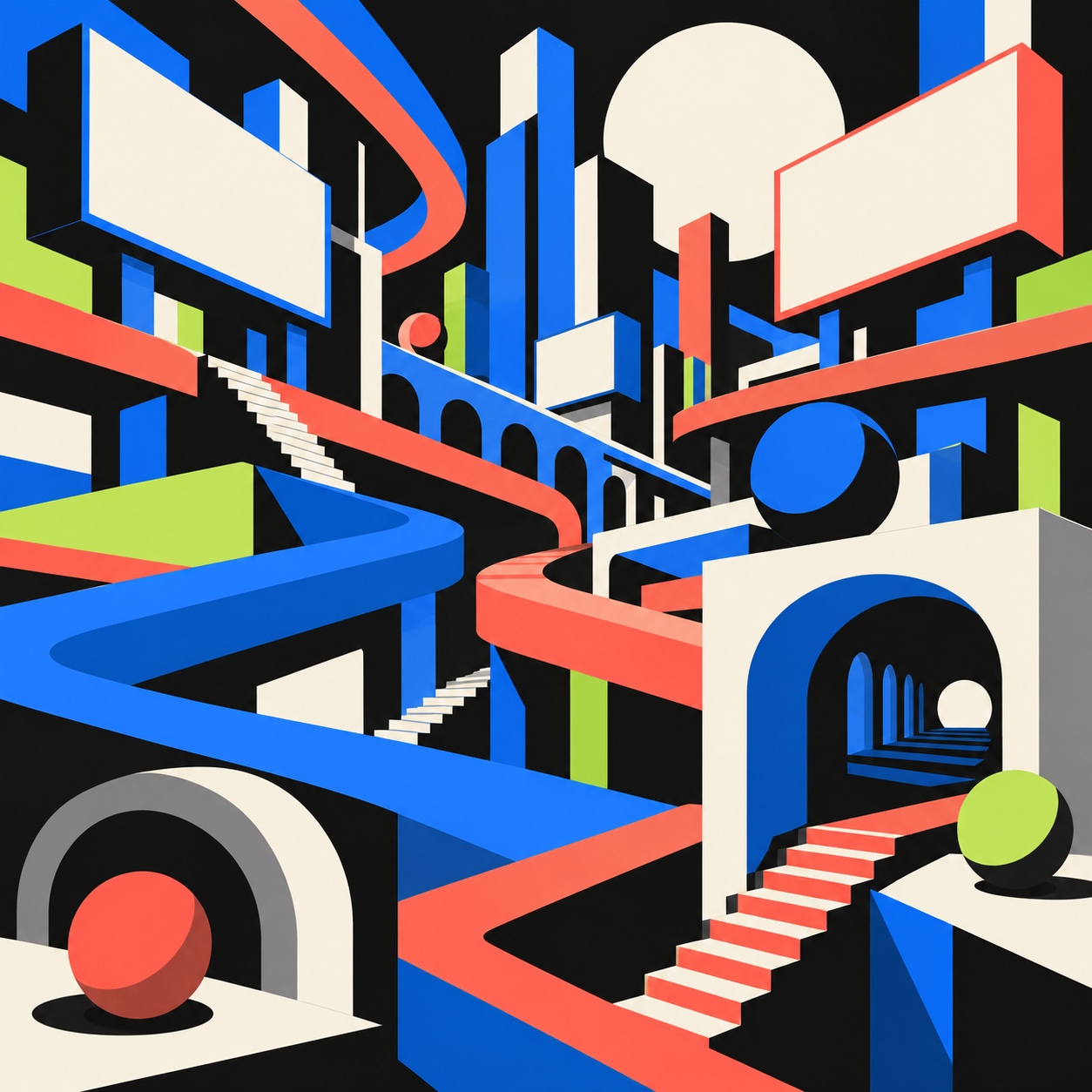
Its stage was set long before software. Giorgio de Chirico's metaphysical paintings of the 1910s emptied Italian piazzas into arcades, towers and long shadows, architecture as a quiet, unsettling set, and M. C. Escher's lithographs, Relativity in 1953 among them, drew impossible stairs and platforms with a draughtsman's precision. Both treated buildings as simple volumes in clean light, which is still this style's vocabulary: the arch, the stair, the sphere on a plinth.
The screen turned it into a craft. In 1982 Sega's Zaxxon became the first arcade game drawn in isometric projection, and pixel artists spent the next two decades building whole worlds from angled planes. Adobe Illustrator, released in 1987, gave designers precise vector shapes, and after flat design took over interfaces in the early 2010s, illustrators began shading those flat shapes to suggest depth: two or three tones per surface, a flat shadow, no render. Monument Valley, released by ustwo games in 2014, turned Escher's architecture into a playable world in exactly that manner and won an Apple Design Award.
Through the late 2010s dimensional vector scenes spread across tech marketing, editorial covers, packaging and murals, often beside the flat, long-limbed people of Facebook's Alegria system of 2017, the look later nicknamed Corporate Memphis. The current version is warmer and stranger: terracotta, sun yellow and cobalt instead of pastel tech blue, surreal stage-sets of arches and oversized fruit, and fine grain that makes the colour feel printed. It works when the world has an idea of its own, and fails when it turns into a generic isometric office.