Registrar's index cards on the platen glass - captured by the scanner
1920–1939 (original); 2010s–present (revival) · New York City (Fleischer Studios); Hollywood (early Disney); US animation industry
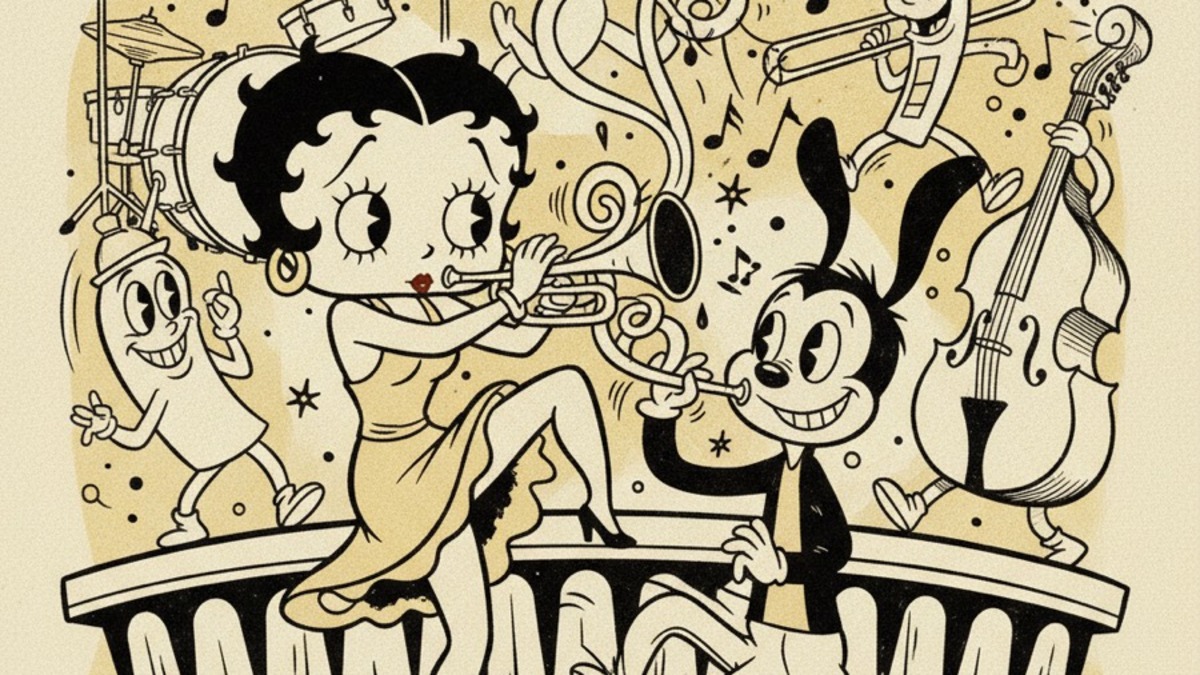
Rubber hose animation developed in the 1920s as animators discovered the conventions that made drawn movement feel fluid and expressive. Characters had no joints: their arms and legs were smooth, flexible tubes that could stretch, bounce, and curl in impossible ways. Eyes were simple circles or ovals. Hands had four fingers, shoes were massive. Mouths opened to comic extremes. Everything could move in any direction without regard for physics or anatomy.
Max Fleischer's studio (Betty Boop, Koko the Clown, Popeye) and early Walt Disney (Steamboat Willie, Mickey Mouse) refined the vocabulary into a golden age. The aesthetic was accompanied by specific musical sensibility: jazz rhythms, syncopated movement, characters that danced and bounced in sync with the soundtrack. Colors were limited by the era: black ink on white paper, with limited color palette when color became available in the mid-1930s.
Contemporary rubber hose revival appears in games (Cuphead being the landmark example), independent animation on TikTok and YouTube, and brand identities that want to signal playfulness and vintage charm. Designers appreciate the constraint: rubber hose characters are expressive and recognizable with minimal complexity, making the style well-suited to illustration, icon design, and mascot creation.
The visual DNA: what makes it recognisable
- Vintage display fonts: Art Deco sans-serifs with rounded corners
- Vaudeville poster typography: condensed circus lettering with thick-thin contrast
- Hand-lettered title cards in the style of 1920s silent film intertitles
- Bouncy, slightly uneven letterforms with organic irregularity
- Centered compositions with generous oval or circular framing
- Symmetrical character poses with arms outstretched for balance
- Limited backgrounds: simple ground plane, horizon, repeating pattern
- Iris-in and iris-out circular framing (a camera technique of the era)
- Ink black: #1A1510: the color of cel animation ink, slightly warm
- Cream white: #F5F0E8: paper or cel background color
- Primary red: #E8312A: simplified, high-contrast color
- Buttercup yellow: #F0C030: the warm golden yellow of early Technicolor
- Limbless arms and legs that coil and stretch impossibly
- Pie-cut eyes: simple circles with highlights that make characters expressive
- White gloves: the universal 1920s cartoon hand convention
- Musical notes, stars, and motion lines as visual sound effects
8-channel console - dominant channels taped & circled by the registrar
Your aesthetic passport - share the fingerprint
4 color interpretations of this aesthetic
Join waitlist for access
Join the waitlist for full access
Join the waitlistRubber Hose: where the language earns its place
Rubber Hose is most effective when its visual decisions do useful work. Fleischer Studios' boneless 1930s animation style - endless elastic limbs, jazz-age energy, and the joyful chaos of early American cartoons
The style gives styling, proportion, and image sequencing a clear point of view rather than treating them as decoration.
It can turn atmosphere, material, and spatial pacing into evidence of a distinct experience before a visitor arrives.
It helps a physical or editorial environment feel authored, which raises attention and perceived care.
They recognize the references, proportion, and restraint that make the language feel intentional.
They respond to visible judgment because it reduces the feeling of interchangeable product.
A coherent aesthetic gives them a usable standard for choosing images, objects, and collaborators.
The cost comes from consistent art direction, suitable locations or materials, and time to edit the details that would otherwise undermine the premise.
The challenge is conceptual. It takes visual literacy and a real point of view to avoid borrowing surface cues without their original logic.
Lighting, casting, type, color, material, and retouching must agree. A single weak choice can make the work feel like an imitation.
Rubber Hose creates its strongest advantage when it gives a brand a standard of judgment, not merely an attractive finish. It fails when recognizable cues are collected without a governing idea. The difference between average and exceptional execution is usually proportion: how much is shown, what is withheld, and whether every element belongs to the same world. The most capable teams pair an exacting art director with specialists who understand the medium, from photographer and stylist to set designer, editor, and typographer.
Should Rubber Hose be the strategic choice?
Surface imitation is easy. The language becomes generic when familiar cues replace proportion, specificity, and a coherent system.
Its visual ingredients appear regularly in contemporary work, but a rigorous execution remains distinguishable from a loose collection of references.
Its strongest principles depend on composition, material, and cultural literacy rather than a short-lived visual effect.
It asks for consistency across photography, typography, motion, environments, and the many details that make a brand feel believable.
Rubber Hose deserves serious consideration from brands and institutions that can articulate a real point of view and protect it through execution. It is less suitable for work that needs immediate instructional clarity, broad visual neutrality, or low-cost production flexibility. Its greatest advantage is differentiation through judgment: it can make a product, place, or editorial proposition feel authored rather than merely packaged. Average executions borrow recognizable signals, then lose coherence when type, casting, copy, or materials fail to agree. Exceptional executions understand the visual language as a system of choices, including what not to show. The largest mistake is treating the style as a finish applied after strategy. Adopt it only when the product and organization can carry the same standard of care the imagery proposes.
Join waitlist for access
Join the waitlist for editorial depth
Join the waitlistConnected across the creative knowledge graph