Thread & Tape

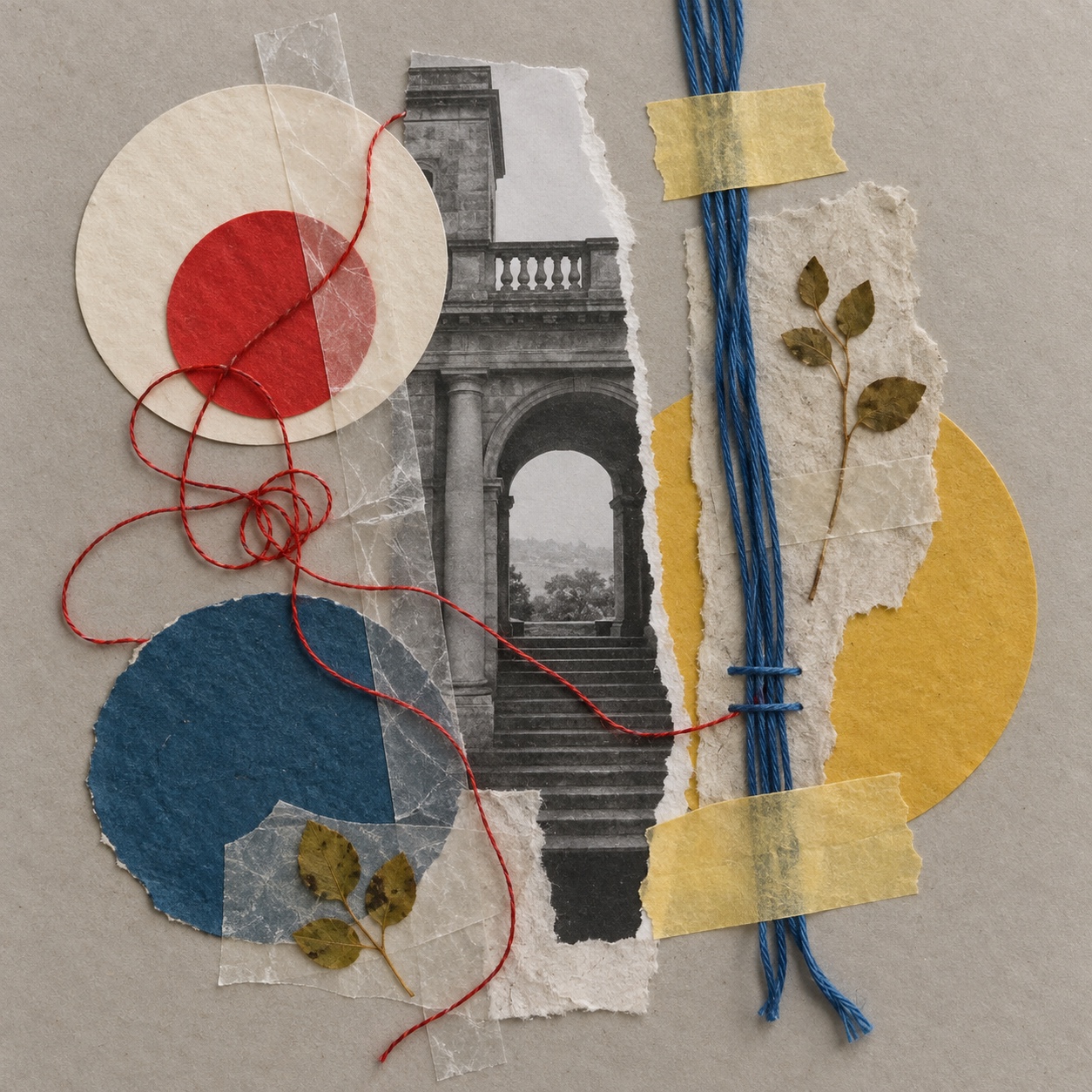
Assembled imagery held together in plain sight: photograph fragments, coloured paper, stitched thread, transparent tape, pins and hand-made joins

Compare Thread & Tape with another style →See the Thread & Tape typefaces →
Record039-TA
AestheticThread & Tape
ClassAnalog / Nostalgic
StatusINGESTING
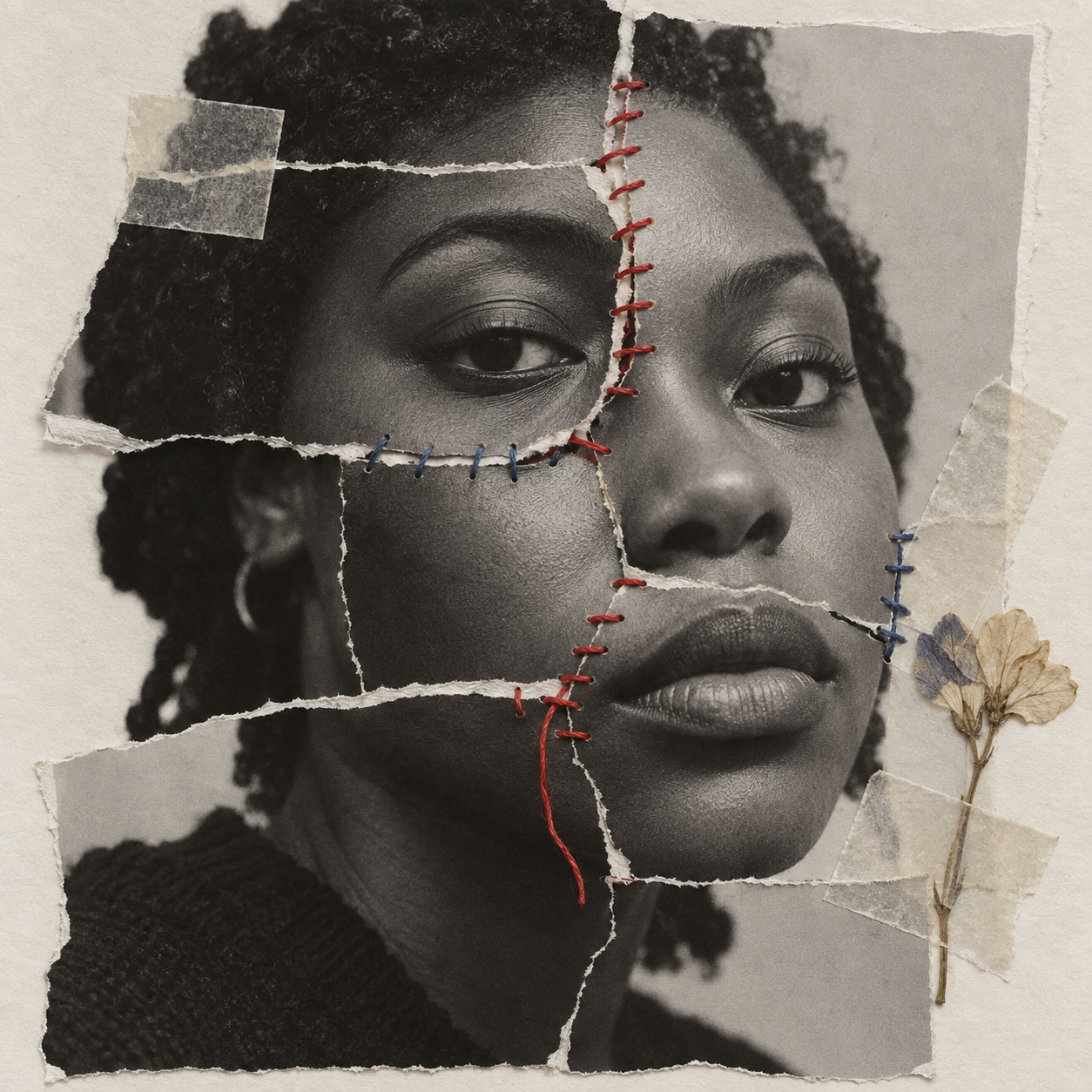
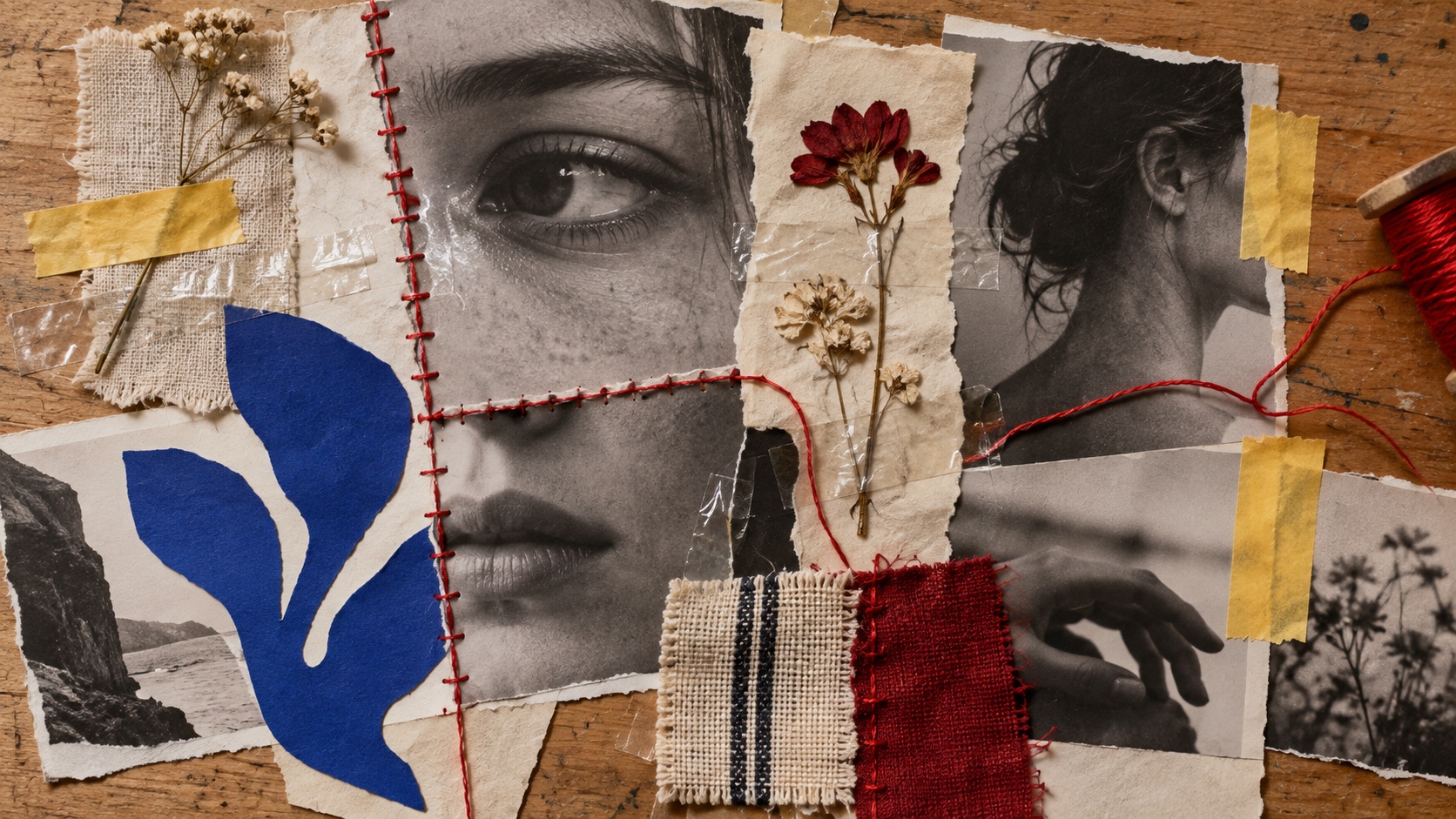
Photograph fragments of faces, pressed flowers, a blue cut-paper shape and red cloth, stitched and taped together on a wooden worktable.
Archive plate · Thread & Tape
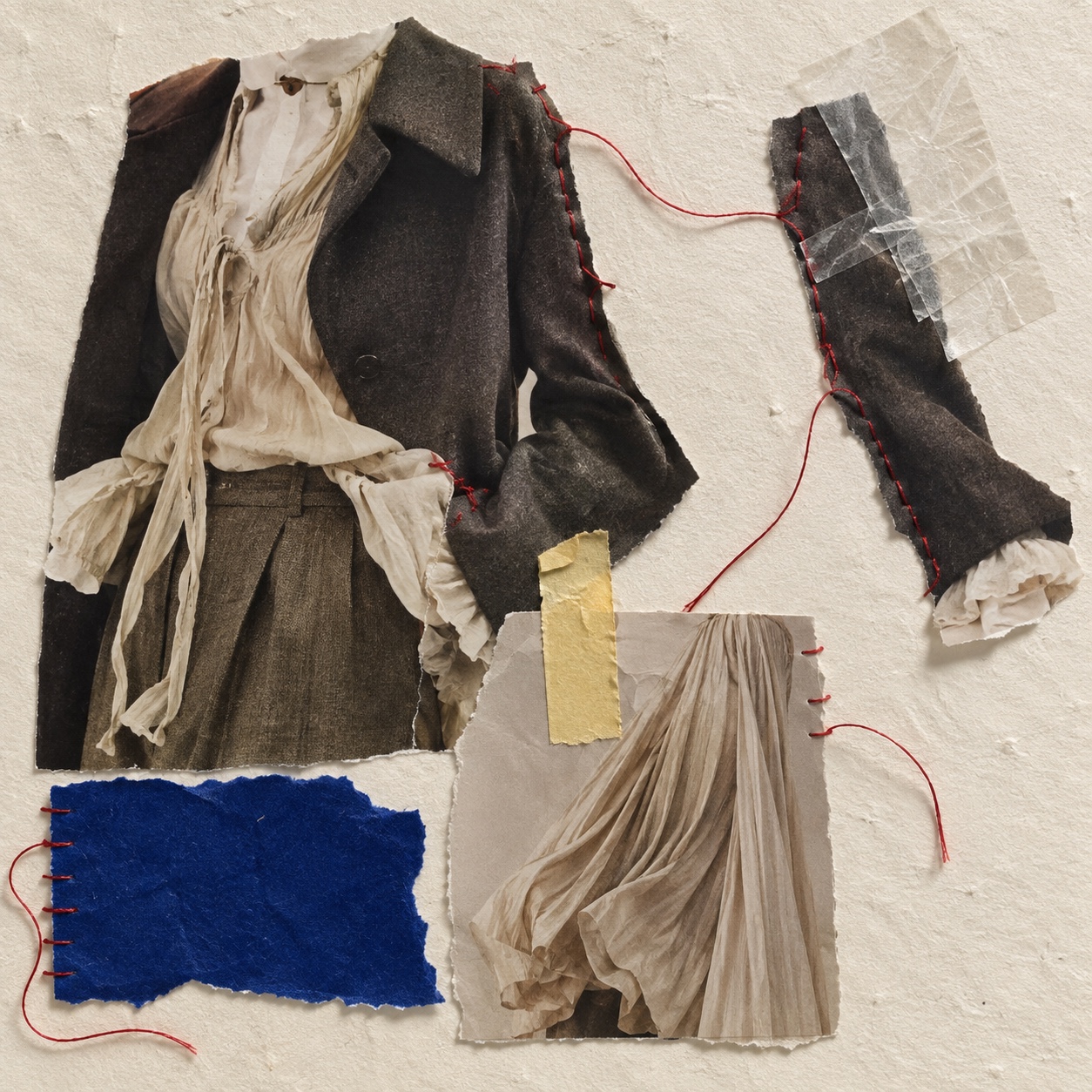
Torn photographs of a jacket, a blouse and a skirt stitched together with red thread, with a scrap of blue paper and strips of tape.
Dossier sceneFashion · 1/5
01
The record

What it is, when it works, who it is for, and where it already exists.

How to use it

Record 039-TA - when it works, who it is for, what it looks like

FIELD 01

When to use it

  • Brands whose value is care, craft and time spent
  • Fashion, textile and interiors campaigns that want the hand to show
  • Editorial and book design about memory, family and making
  • Portfolios, exhibitions and moodboards presented as physical objects
FIELD 02

Perfect for

  • Fashion and textile labels
  • Craft, homeware and stationery brands
  • Photobook and independent publishers
  • Galleries, studios and creative agencies
FIELD 03

What it looks like

  • Hannah Höch's photomontages, from 1919, cut and joined by hand
  • Transparent cellophane tape, developed by Richard Drew at 3M, 1930
  • Annegret Soltau, Selbst, 1975, self-portraits stitched with black thread
  • Maurizio Anzeri's thread embroidered into found vintage photographs

In the wild, Thread & Tape aesthetic real-world examples

Where this aesthetic shows up in the real world · ↗ opens the source site

Omoro Style GuideEvery aesthetic, every field on this page, in one PDF.
Get the guide →
02
The anatomy

Where Thread & Tape came from, what makes it recognisable, and the fingerprint it leaves.

History, Thread & Tape aesthetic history

1919 to now · Photomontage, stitched photography and the studio pinboard

Joining images by hand is as old as photomontage. In Berlin in 1919 Hannah Höch began cutting photographs from magazines and assembling them into pictures such as Cut with the Kitchen Knife, leaving the cuts and joins visible as part of the argument. A decade later the join itself changed: in 1930 Richard Drew, an engineer at 3M, developed transparent cellophane tape, and a clear strip that could hold paper together without hiding it became part of every studio, office and bedroom wall.

Thread arrived as a way of drawing on a photograph with a needle. In 1975 the German artist Annegret Soltau made Selbst, self-portraits in which her face is bound and then stitched over with black thread, and the needle became her signature. More recently the London-based Italian artist Maurizio Anzeri has embroidered bright thread into found vintage photographs, masks and auras sewn over strangers' faces, and a generation of textile artists and photographers has made the stitched print a recognised form.

As a visual language it is the studio made visible. The moodboard pinned to a wall, the fitting photographed with its tape and pins, the proof stitched to a card: fashion, publishing and creative studios now show the assembly rather than hiding it, partly in answer to images that look generated and weightless. What separates it from scrapbooking is restraint and function. Every stitch, strip of tape and pin does structural work, the fragments are few and the palette is held tight.

An image held together in plain sight.

Omoro dossier · 039-TA

Visual markers, Thread & Tape aesthetic visual markers

The visual DNA: what makes it recognisable

typography

See the fonts
  • Small typewriter or grotesk captions on paper labels
  • Handwritten notes on strips of tape
  • Stamped numbers and dates
  • Occasional letters cut from paper and stitched in place

grid

  • Fragments arranged on a board, table or wall rather than a digital canvas
  • Seams and joins placed deliberately, often across the subject
  • A generous ground of linen, card or wall around a few pieces
  • Straight-down or gently raking views that show the relief

materials

  • Studio linen #E1D7C9 as the ground, worktable brown #824923 underneath
  • Thread red #A8302A and cobalt paper #1F3A80 as accents
  • Tape yellow #DFB04F and pin silver in the joins
  • Photographic prints, coloured paper, cotton and silk thread, cellophane and paper tape, pins

motifs

  • Torn portraits stitched back together
  • Strips of transparent tape with lifted, yellowing edges
  • Running stitches and cross-stitches through photographic paper
  • Pins, clips and staples casting small shadows

Aesthetic profile

8-channel console with the fingerprint on its display. Save the card, or share the page

Aesthetic Profile
Thread & Tape
1919 to now · Photomontage, stitched photography and the studio pinboard
Attribute console · 039-TA
leans analog, nostalgic, light
8 CH
FIG. 1
MaximalMinimalAnalogDigitalExpressiveRestrainedWarmCoolNostalgicFuturisticChaoticStructuredLightDarkOrganicGeometric
01Minimal
Maximal20%
02Analog
Digital90%
03Restrained
Expressive20%
04Cool
Warm40%
05Futuristic
Nostalgic50%
06Structured
Chaotic10%
07Dark
Light50%
08Organic
Geometric40%
AnalogNostalgicLight
Omoro · Attribute console · 039-TA
omoro.io/styles/thread-and-tape

Color Palettes, Thread & Tape color palettes and hex codes

The definitive color scheme for this aesthetic

Thread & Tape
#E1D7C9 · #DFB04F · #A8302A · #1F3A80 · #824923
A worktable at the end of an afternoon: linen paper, yellow tape, a red thread, a scrap of cobalt paper and the wood underneath
Omoro Palette Pack575 curated palettes across every aesthetic, 5 export formats.
Get the palettes →

Adjacent Palettes, styles related to Thread & Tape

The colour of the styles sitting closest to this one

Collage
Artisanal Textile
Mixed Media
Dada
03
The direction

How to shoot it, how to prompt it, and how to board it.

Photo Direction

How to shoot this aesthetic

"Photograph the assembly as an object: thread, tape and pins in focus, with real shadows"

Shot list

  • A torn portrait stitched back together with red running thread, laid on linen and lit from the side
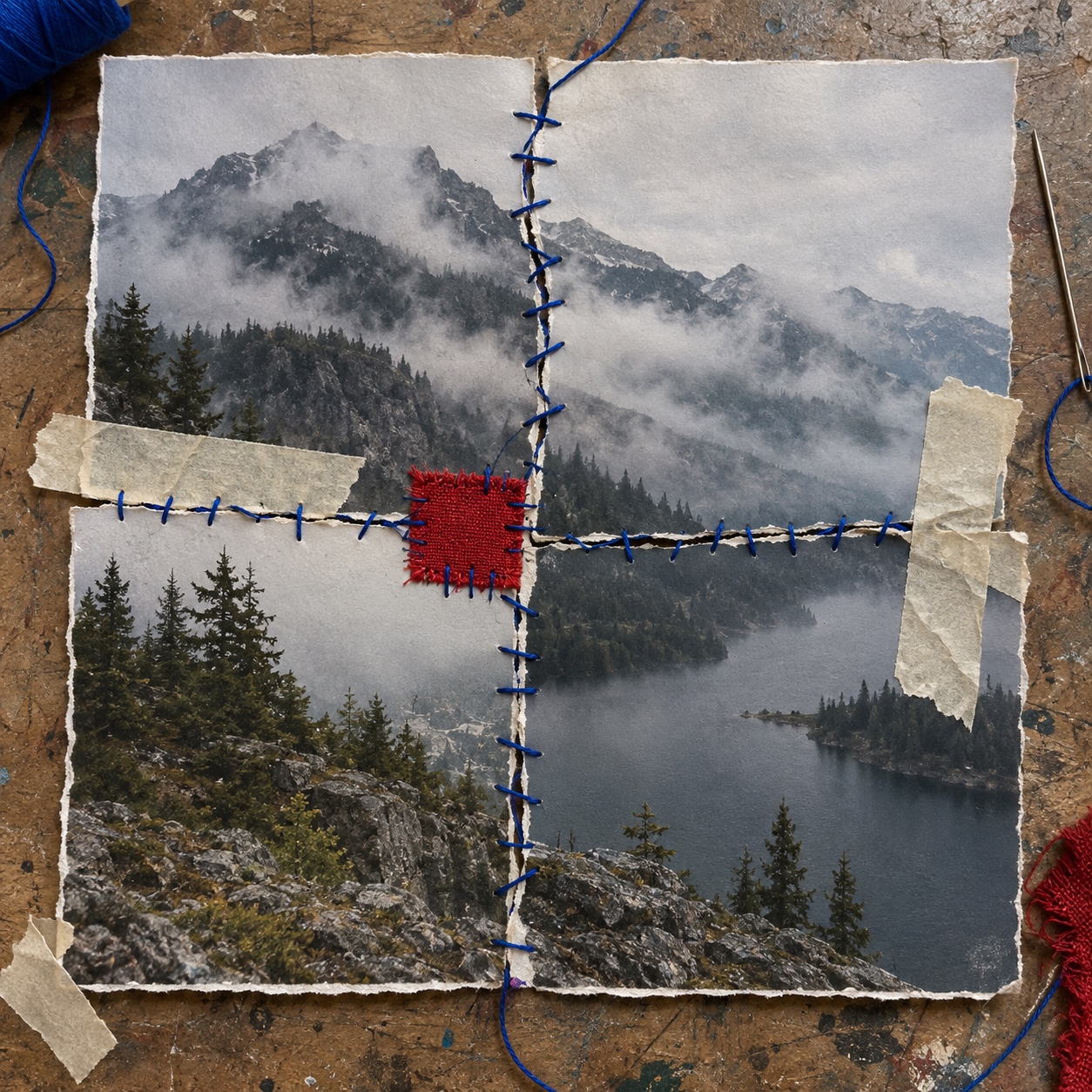
  • A landscape built from four photograph fragments joined by strips of yellowing tape
  • A fashion image pinned to a studio wall with paper swatches and a handwritten label

Lighting

Soft, directional daylight from one side, low enough that stitches, tape edges and pins cast small shadows. Natural and slightly warm; the relief is what separates it from a flat collage.

Omoro Director's Briefs200 photo shot-lists like this one, ready to shoot from.
Get the briefs →

Generative Prompt

Drop this into Studio to generate in this aesthetic

Thread and tape aesthetic, an assembled composition held together in plain sight, torn and cut photograph fragments joined with visible stitched thread, strips of transparent and yellow tape with lifted edges, cobalt-blue and red paper pieces, pins casting small shadows, running stitches through photographic paper, handwritten labels on tape, laid on linen or a worktable, soft directional daylight, tactile, patient and domestic, art-directed and calm, no stickers, no glitter, no clip art, no readable text

Paste as-is, or append your own subject

Mood Board

The record applied to your project. The record's kit is free; your brand, references and plates come with membership

Mood board
The Thread & Tape board
8 frames · 4 selected
FIG. 4
Studio LinenE1D7C9Tape YellowDFB04FThread RedA8302ACobalt Paper1F3A80Worktable Brown824923
Brand and references
IdleBrand and references open with membership
With membership: the brand's own facts and colours in every prompt, references carried into every frame, and the plates generated.
01 · Hero application
02 · Material and finish
03 · Palette in context
04 · Photography direction
05 · Pattern plate
06 · Object
07 · Environment
08 · Digital presence
Demo kit free, the rest with membershipThe record as a demo kit, free. Name a project and it is written for that
Omoro · Mood board · 039-TA
04
The judgement

Whether to use it, what it costs to do properly, and where it stands right now.

Creative verdict, Thread & Tape feasibility and strategic recommendation

Two written calls, seven meters, and when to walk away

Creative verdict
Should Thread & Tape be the call?
7 meters
FIG. 2
Assessment

Build it physically and photograph it. Make the joins the subject: the stitch, the tape and the pin hold the composition and are where the eye should land. Keep the fragments few, the palette narrow and the arrangement deliberate. Stickers, patterned tape and glitter turn it into a scrapbook page, and a flat digital assembly loses the shadows that make it work.

Verdict

Right when the brand wants its care to be visible: fashion and textile labels, craft and homeware, publishers and studios. It rewards patience, restraint and real materials, and exposes anything assembled on a screen.

Production cost
Low

Paper, thread, tape, pins and prints. The cost is time, not materials.

Creative difficulty
High

Deciding what to join, where the seams fall and what the stitches say is the design; the materials alone do nothing.

Execution difficulty
High

Stitching through photographic paper, taping cleanly and lighting the joins so they read takes practice and patience.

Risk of misuse
Medium

Crowded with stickers and decorative tape, it collapses into scrapbooking.

Prevalence
Emerging

It is appearing across fashion, publishing and studio portfolios as a response to glossy, generated images.

Longevity
Enduring

Artists have stitched, pinned and taped photographs for a century, and the gesture keeps returning.

Brand investment
Medium

Materials are cheap; the hours of making and the photography are the real cost.

Avoid if
The brand needs speed or high-volume content
Every piece is made by hand and photographed; it does not scale to daily output.
The plan is stickers, decorative tape and embellishment
That is scrapbooking; the style depends on functional joins and restraint.
The work will only ever be assembled on screen
Without real thread, tape and shadows, the joins look pasted on.
Omoro · Creative verdict · 039-TA

Editorial Depth

A Pro feature: origins, practitioners, and pitfalls

Editorial depth
The Thread & Tape file
14 sections
FIG. 3
Context02Brands02Perception04Use04Index02
01Common MisconceptionThe principle beneath the surface
02Historical ContextOrigins, cultural moment, and reaction
03Brands That Accidentally Use This StyleNatural alignment, not category claims
04Brands That Perfectly Represent This StyleExceptional execution
05Psychological EffectHow visual decisions change perception
06Visual ChecklistInclude and avoid
07Creative FormulaThe visual system reduced to essentials
08Recognition SignalsHow to recognize it in two seconds
09When To Use This StyleContexts where the language performs
10Common Creative MistakesWhere imitation weakens the signal
11Best Brand ApplicationsIndustries with a natural advantage
12Creative Application AnalysisFit, feasibility, and production reality
13Related StylesClose languages and the key distinction
14Visual DNA SummaryThe sentence to remember
The editorial depth, with membershipOpening soon
Omoro · Editorial depth · 039-TA
05
The index

Neighbours, cross-references, blends, and the questions people ask.

Related concepts

Connected across the creative knowledge graph

Cultural relevance, Thread & Tape cultural relevance today

Where it stands now, and what it costs you to use it

Thread & Tape answers the weightlessness of screen images. When most pictures arrive generated, filtered and flat, an image whose seams are visible, stitched, taped and pinned, reads as made by someone over time. That is why it runs through fashion lookbooks, independent publishing, studio portfolios and textile brands.

Its failure mode is the scrapbook. Decorative tape, stickers, glitter and crowded pages turn it into a hobby aesthetic. The work that holds up uses a few fragments, joins that do real structural work and a narrow palette, and is photographed as a physical object with its shadows intact.

Cross-references

CollageThe louder, poster-scale cousin built from cut imagesArtisanal TextileThe craft of thread and cloth it borrows its stitches fromMixed MediaThe wider practice of combining materials in one workDadaHannah Höch's photomontage is where the visible join began

Blend

Mix Thread & Tape with any style in the library

Thread & Tape×
50%50%
83% alike
Thread & Tape referenceCollage referenceThread & Tape 50%Collage 50%

Merged palette

#E1D7C9

#263238

#DFB04F

#8D6E63

#A8302A

Leads analog, nostalgic, expressive

Typography · from Thread & Tape

Zilla Slab over Source Sans 3

Materials

  • Studio linen #E1D7C9 as the ground, worktable brown #824923 underneath
  • Thread red #A8302A and cobalt paper #1F3A80 as accents
  • Paper textures: newsprint #D4D0C8, aged paper #D4B483, photographic paper white #F5F0E8

Use it

Thread and tape aesthetic, an assembled composition held together in plain sight, torn and cut photograph fragments joined with visible stitched thread, strips of transparent and yellow tape with lifted edges, cobalt-blue and red paper pieces, pins casting small shadows, running stitches through photographic paper, handwritten labels on tape, laid on linen or a worktable, soft directional daylight, tactile, patient and domestic, art-directed and calm, no stickers, no glitter, no clip art, no readable text (50%), infused with Poster collage with photomontage cut-and-paste layering, Dada and Constructivist influence, mismatched scales and unexpected juxtapositions, halftone printed textures, aged paper background with foxing and yellowing, torn edges and tape marks, Hannah Hoch-inspired visual tension, color palette strictly #E1D7C9 #263238 #DFB04F #8D6E63 #A8302A, overall character: analog, nostalgic, expressive

One-click generation opens with the studio

About this aesthetic

What is the thread and tape aesthetic?

Assembled imagery in which photograph fragments, coloured paper, stitching, thread, transparent tape and pins visibly hold a composition together. The tone is tactile, patient and domestic, but the result is art-directed: few fragments, deliberate joins and a narrow palette, photographed as an object.

Is it just scrapbooking?

No. Scrapbooking decorates; thread and tape constructs. The joins are functional and placed on purpose, the fragments are few, the palette is narrow, and there are no stickers, glitter or patterned tape. It sits closer to a maker's worktable or a stitched photograph than to a memory album.

Why does it feel so personal?

Visible joins show time and care. A stitch through a photograph or a strip of tape across a torn edge tells the viewer that somebody handled this picture, repaired it and kept it, so the image reads as intimate and trustworthy rather than produced.

How is it made?

Physically. Print the photographs, tear or cut them, join them with thread, tape and pins on a linen or card ground, then photograph the assembly in soft side light so stitches and tape edges cast small shadows. Keep one thread colour, a handful of fragments and a narrow palette.

Build with the thread & tape aesthetic

Every style in the library is broken down like this one: the palette, the typography, the materials and the lineage.

Explore the style library →