Sculptural Couture

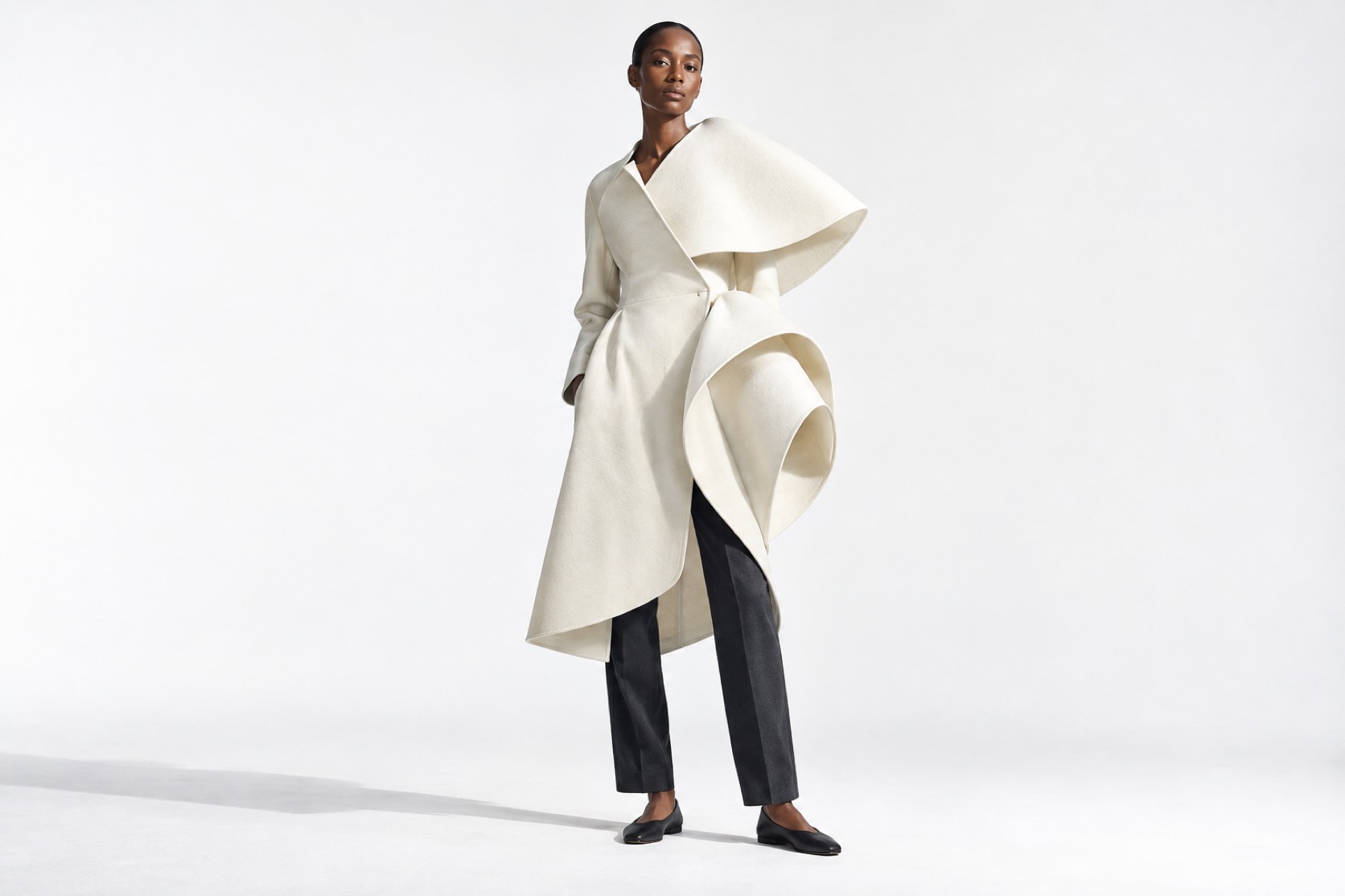
Garments built as volume: curved panels, architectural folds and controlled asymmetry that hold their shape away from the body

Compare Sculptural Couture with another style →See the Sculptural Couture typefaces →
Record038-SC
AestheticSculptural Couture
ClassStructured / Analog
StatusINGESTING
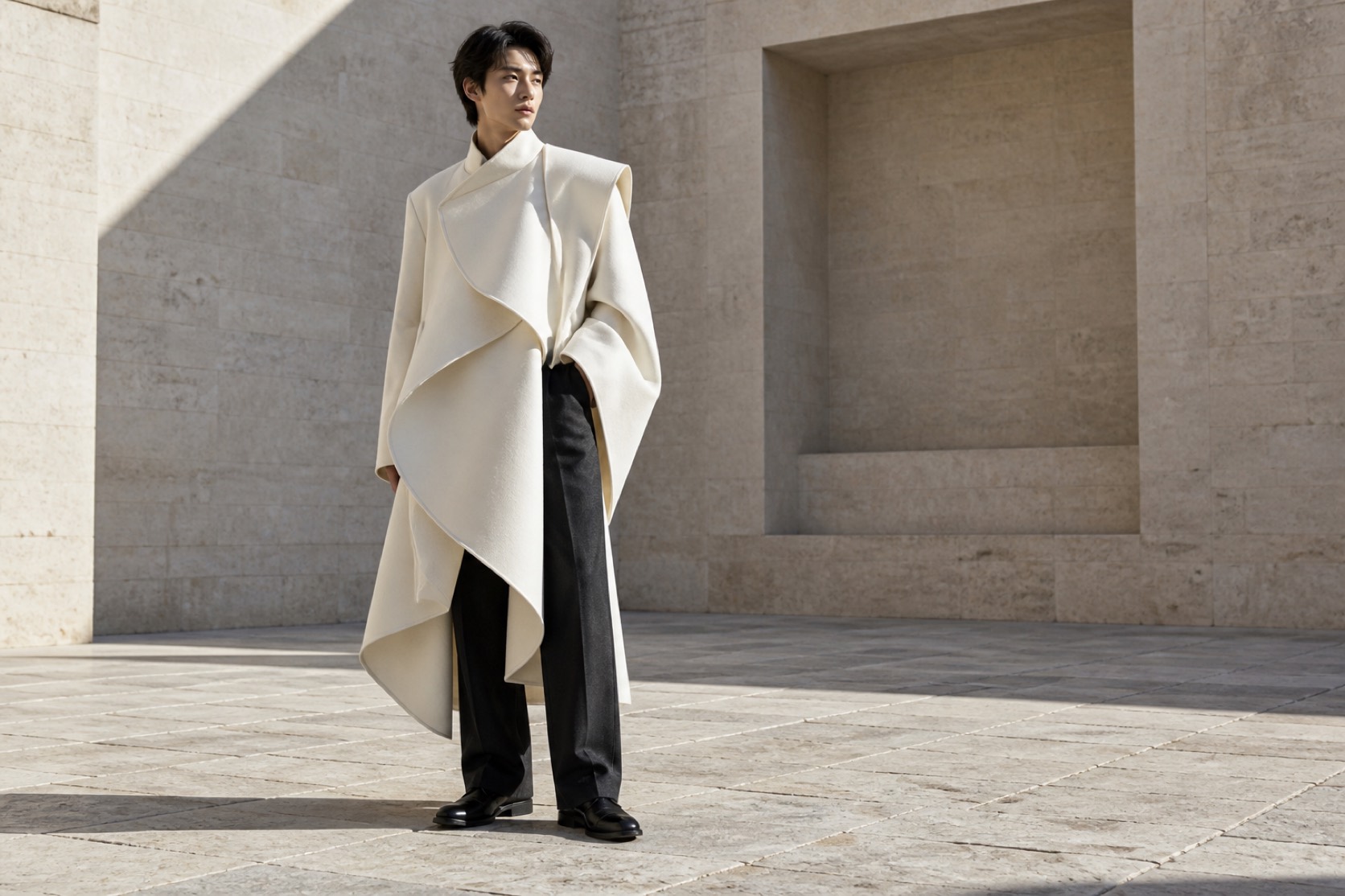
A model wears an ivory coat with sculptural folded volumes and charcoal trousers.
Archive plate · Sculptural Couture
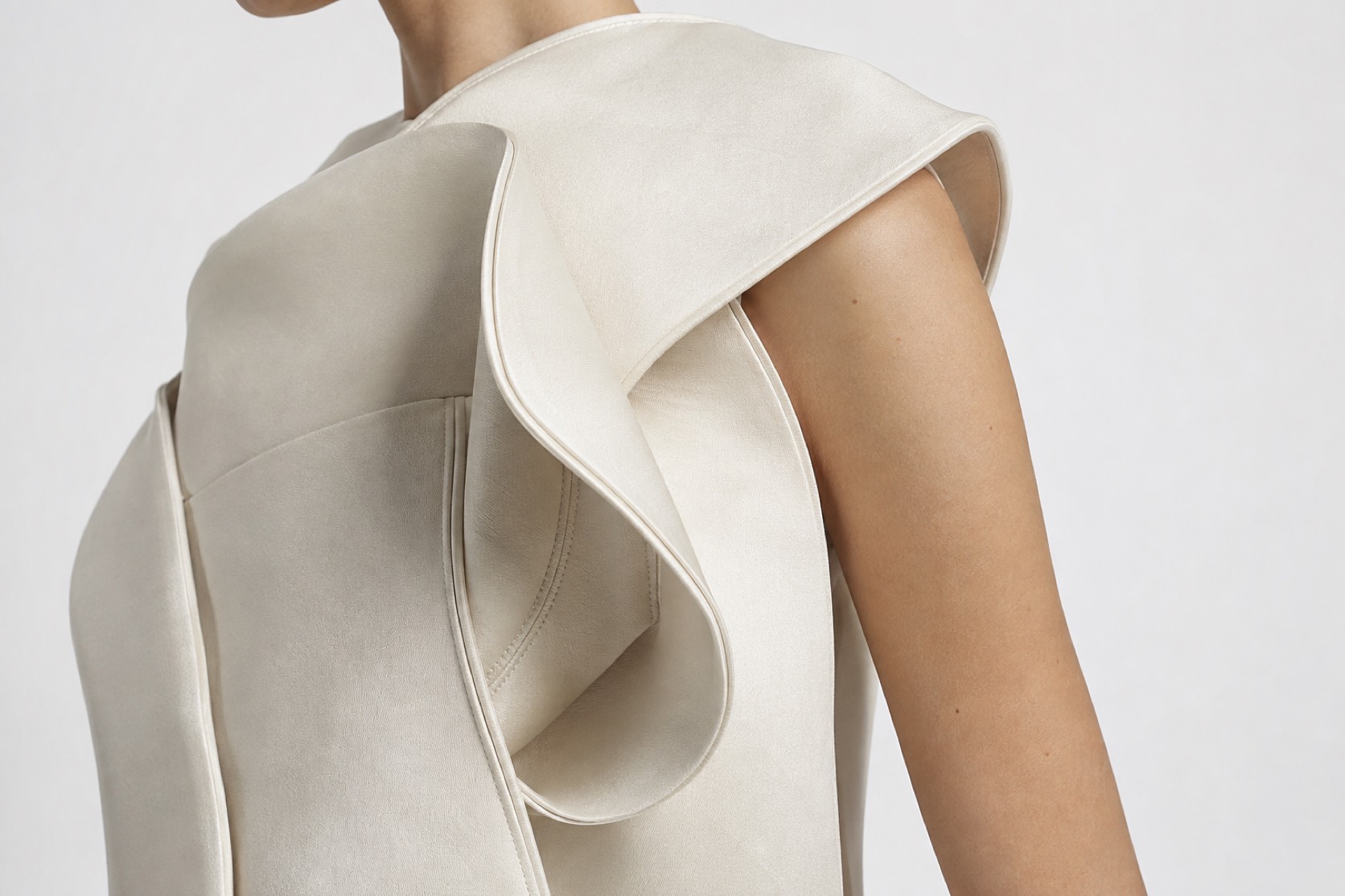
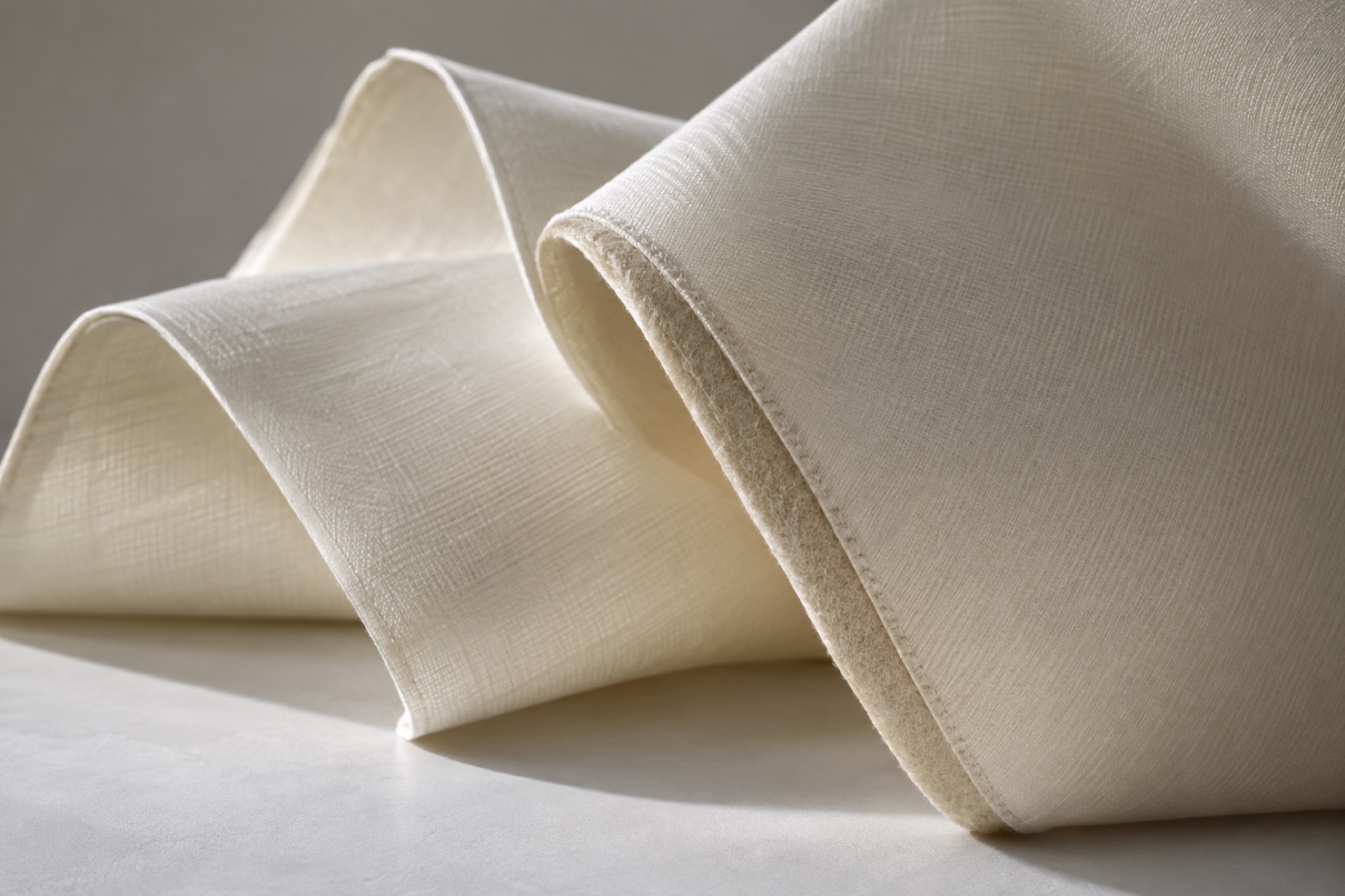
Close view of an ivory garment’s curved folded seam and hollow fabric volume.
Dossier sceneConstruction · 1/3
01
The record

What it is, when it works, who it is for, and where it already exists.

How to use it

Record 038-SC - when it works, who it is for, what it looks like

FIELD 01

When to use it

  • Couture and eveningwear where the silhouette is the message
  • Campaigns for houses whose craft is construction rather than decoration
  • Editorial that treats the body as an armature and the space around it as part of the picture
  • Product design and packaging that borrows the idea of a held curve
FIELD 02

Perfect for

  • Couture and bridal houses
  • Fashion and culture magazines
  • Museum and exhibition communication
  • Fragrance and beauty launches with a sculptural bottle
FIELD 03

What it looks like

  • Cristobal Balenciaga, envelope dress, 1967
  • Charles James, Clover Leaf gown, 1953
  • Roberto Capucci, pleated sculpture dresses, 1980s
  • Hussein Chalayan, Before Minus Now, 2000

In the wild, Sculptural Couture aesthetic real-world examples

Where this aesthetic shows up in the real world · ↗ opens the source site

Couture, structured evening dressCharles James, Clover Leaf gown (opens in a new tab)1953
Runway collection, mechanical dressHussein Chalayan, Before Minus Now (opens in a new tab)2000
Omoro Style GuideEvery aesthetic, every field on this page, in one PDF.
Get the guide →
02
The anatomy

Where Sculptural Couture came from, what makes it recognisable, and the fingerprint it leaves.

History, Sculptural Couture aesthetic history

1950s to present · Paris couture, and the ateliers that could make a curve stand

The idea that a garment could be a held shape rather than a covering belongs above all to Cristobal Balenciaga. Working in Paris from 1937, he cut away from the body rather than towards it, and by the 1950s his coats and dresses stood clear of the wearer at the shoulder, the waist and the hem. The 1967 envelope dress, four seams and a shape that keeps itself, is the summary object. He was helped by material: silk gazar, developed for him by the Swiss mill Abraham at the end of the 1950s, was crisp and dry enough to hold a curve without lining or padding, and it changed what a single layer of cloth could be asked to do.

In New York, Charles James was building the same argument by the opposite method. His gowns of the late 1940s and early 1950s, of which the Clover Leaf of 1953 is the most photographed, were engineered from the inside with boning, buckram and weighted underskirts, so that the outer silk described a shape the body was not making. James spoke of his dresses as sculpture and priced them accordingly; several took years. Where Balenciaga removed structure until the cloth did the work, James added it until the cloth had no choice.

The thread runs on. Roberto Capucci left the fashion calendar in the 1980s to make pleated silk sculptures shown in museums rather than seasons. Issey Miyake and Rei Kawakubo asked what happens when volume ignores the body entirely. Hussein Chalayan's Before Minus Now in 2000 built garments that changed shape mechanically. What unites them is a discipline rather than a look: the shape has to hold. A silhouette that depends on a wind machine, a hand on a hip or a retoucher is a photograph of a dress, not a sculptural garment, and the difference is visible to anyone who has watched a model stand still.

Cloth persuaded to hold a shape, and the empty air around the body counted as part of the dress.

Omoro dossier · 038-SC

Visual markers, Sculptural Couture aesthetic visual markers

The visual DNA: what makes it recognisable

typography

See the fonts
  • A light grotesk set small, with generous margins and nothing near the garment
  • Captions kept to a corner, so the silhouette owns the page
  • No type across the photograph; the outline is the composition

grid

  • The figure placed small in a large empty field, the negative space treated as part of the garment
  • One angle per garment, chosen because the volume reads there and nowhere else
  • Full-length and unbroken: the hem's distance from the leg is the information
  • Plain floor and plain wall, so the only shape in the frame is the one that was made

materials

  • Bone #EDE6DA and ivory gazar #F6F2EA against ink black #141416
  • Oyster #B8A98F for bonded wool, with one saturated accent used once across a set
  • Silk gazar, bonded wool, structured duchesse satin, crisp organza, horsehair and boning

motifs

  • A collar or hem that stands away from the body by a measurable distance
  • Curved seams that describe a volume rather than a fit
  • Controlled asymmetry: one side answering the other rather than mirroring it
  • A single fold pressed hard enough to cast its own shadow

Aesthetic profile

8-channel console with the fingerprint on its display. Save the card, or share the page

Aesthetic Profile
Sculptural Couture
1950s to present · Paris couture, and the ateliers that could make a curve stand
Attribute console · 038-SC
leans structured, analog, light
8 CH
FIG. 1
MinimalMaximalAnalogDigitalExpressiveRestrainedCoolWarmNostalgicFuturisticStructuredChaoticLightDarkGeometricOrganic
01Minimal
Maximal30%
02Analog
Digital50%
03Restrained
Expressive40%
04Cool
Warm20%
05Futuristic
NostalgicEVEN
06Structured
Chaotic70%
07Dark
Light50%
08Organic
Geometric40%
StructuredAnalogLight
Omoro · Attribute console · 038-SC
omoro.io/styles/sculptural-couture

Color Palettes, Sculptural Couture color palettes and hex codes

The definitive color scheme for this aesthetic

Sculptural Couture
#EDE6DA · #F6F2EA · #B8A98F · #141416 · #C8102E
Bone, ivory and black with the light doing the colour: a held curve reads in one highlight
Omoro Palette Pack575 curated palettes across every aesthetic, 5 export formats.
Get the palettes →
03
The direction

How to shoot it, how to prompt it, and how to board it.

Photo Direction

How to shoot this aesthetic

"Photograph the shape, not the dress: one angle where the volume reads, one light that lets a fold make its own shadow"

Shot list

  • Full-length front-on shot of a figure in a bonded-wool coat built from four curved panels, the hem standing away from the legs by a hand's width, plain pale floor and wall, the space around the silhouette left empty
  • Three-quarter shot of a silk gazar dress whose collar rises into a single held curve behind the head, one soft key from the side so the curve casts a shadow on the shoulder
  • Close construction detail of a bonded seam where two curved panels meet, the horsehair interlining just visible at the opening, raking light across the join

Lighting

One large soft key and a black flag on the shadow side. The fold has to make its own shadow, so no fill on the dark side and no second source. Daylight through a north window is the reference.

Omoro Director's Briefs188 photo shot-lists like this one, ready to shoot from.
Get the briefs →

Generative Prompt

Drop this into Studio to generate in this aesthetic

Sculptural couture, a garment built as constructed volume in silk gazar, bonded wool or crisp organza, curved panels and architectural folds that hold their shape away from the body, controlled asymmetry, exaggerated proportion with negative space around the figure, studio daylight with one soft key, bone, ivory and black with one accent, photographic, not CGI, no spikes, no flowing evening gown

Paste as-is, or append your own subject

Mood Board

The record applied to your project. The record's kit is free; your brand, references and plates come with membership

Mood board
The Sculptural Couture board
8 frames · 4 selected
FIG. 4
BoneEDE6DAIvory GazarF6F2EAOysterB8A98FInk Black141416One AccentC8102E
Brand and references
IdleBrand and references open with membership
With membership: the brand's own facts and colours in every prompt, references carried into every frame, and the plates generated.
01 · Hero application
02 · Material and finish
03 · Palette in context
04 · Photography direction
05 · Pattern plate
06 · Object
07 · Environment
08 · Digital presence
Demo kit free, the rest with membershipThe record as a demo kit, free. Name a project and it is written for that
Omoro · Mood board · 038-SC
04
The judgement

Whether to use it, what it costs to do properly, and where it stands right now.

Creative verdict, Sculptural Couture feasibility and strategic recommendation

Two written calls, seven meters, and when to walk away

Creative verdict
Should Sculptural Couture be the call?
7 meters
FIG. 2
Assessment

Photograph the shape, not the dress. Choose the one angle at which the volume reads and light it with a single soft source so the fold makes its own shadow. Keep the floor and the wall plain and give the figure more air than feels necessary; the negative space is part of the garment. If the silhouette needs the wind machine or the retoucher to hold, it was never sculptural.

Verdict

Right when the brand's craft is construction and one silhouette can stand for the house: couture, bridal, a sculptural bottle, an exhibition. It is expensive because it is real. Borrow the discipline, the plain ground and the negative space, even when the budget cannot stretch to gazar; never borrow the shape without the structure that holds it.

Production cost
High

Gazar, bonded wool and the hours of an atelier that can make a curve hold. The garment is the budget.

Creative difficulty
Medium

The idea is one thing, a held shape; the judgement is in how far to push proportion before it becomes a costume.

Execution difficulty
High

A curve that does not hold is a sag. Interlining, boning and pressing decide the picture before the camera does.

Risk of misuse
Medium

A dress with a big shape is not sculpture; the difference is whether the shape holds by construction.

Prevalence
Rare

It lives in couture, bridal and museum shows, and rarely reaches a brand system.

Longevity
Timeless

Balenciaga's held curves have not aged in sixty years, because geometry does not.

Brand investment
High

One garment, one shoot, and the picture carries a season; there is no cheap version.

Avoid if
The garment cannot be built to hold its shape
A curve held by a wind machine or a retoucher is a sag with help. The style is the construction.
The brief wants softness, flow or ease
Sculptural means held, exact and a little unyielding. A flowing gown is a different picture.
Omoro · Creative verdict · 038-SC

Editorial Depth

A Pro feature: origins, practitioners, and pitfalls

Editorial depth
The Sculptural Couture file
14 sections
FIG. 3
Context02Brands02Perception04Use04Index02
01Common MisconceptionThe principle beneath the surface
02Historical ContextOrigins, cultural moment, and reaction
03Brands That Accidentally Use This StyleNatural alignment, not category claims
04Brands That Perfectly Represent This StyleExceptional execution
05Psychological EffectHow visual decisions change perception
06Visual ChecklistInclude and avoid
07Creative FormulaThe visual system reduced to essentials
08Recognition SignalsHow to recognize it in two seconds
09When To Use This StyleContexts where the language performs
10Common Creative MistakesWhere imitation weakens the signal
11Best Brand ApplicationsIndustries with a natural advantage
12Creative Application AnalysisFit, feasibility, and production reality
13Related StylesClose languages and the key distinction
14Visual DNA SummaryThe sentence to remember
The editorial depth, with membershipOpening soon
Omoro · Editorial depth · 038-SC
05
The index

Neighbours, cross-references, blends, and the questions people ask.

Related concepts

Connected across the creative knowledge graph

Cultural relevance, Sculptural Couture cultural relevance today

Where it stands now, and what it costs you to use it

Sculptural couture is the clearest argument fashion makes for itself as construction rather than styling. For a house, a museum or a launch, one silhouette can stand in for the whole enterprise, which is why it survives in bridal, fragrance and exhibition work far from the runway that produced it.

It is also the hardest to borrow. The look depends on interlining, pressing and pattern work that cost real money, so an imitation reads instantly as a big dress rather than a held one. Brands that cannot afford the garment can still borrow the discipline: the plain ground, the single light, the empty air, the refusal to fill the frame.

Cross-references

Fashion DesignThe wider field this is the most constructed corner ofSurrealist FashionThe same atelier skills turned to illusion rather than to volumeLuxury MinimalShares the empty ground and the single light, without the engineered shapeParametric ArchitectureThe same curved-panel logic at building scale

Blend

Mix Sculptural Couture with any style in the library

Sculptural Couture×
50%50%
58% alike
Sculptural Couture referenceFashion Design referenceSculptural Couture 50%Fashion Design 50%

Merged palette

#EDE6DA

#2A2018

#8A7A6A

#B8A98F

#141416

Leads expressive, analog, structured

Typography · from Sculptural Couture

Cormorant Garamond over Lora

Materials

  • Bone #EDE6DA and ivory gazar #F6F2EA against ink black #141416
  • Oyster #B8A98F for bonded wool, with one saturated accent used once across a set
  • No house palette: each fashion house has its own signature color register

The calls this blend forces

These two disagree on 2 things, and a blend cannot average them: you pick a side. At this mix:

Structured or Chaotic? Sculptural Couture is structured, Fashion Design is chaotic. This mix lands structured.

Geometric or Organic? Sculptural Couture is geometric, Fashion Design is organic. This mix lands geometric.

Use it

Sculptural couture, a garment built as constructed volume in silk gazar, bonded wool or crisp organza, curved panels and architectural folds that hold their shape away from the body, controlled asymmetry, exaggerated proportion with negative space around the figure, studio daylight with one soft key, bone, ivory and black with one accent, photographic, not CGI, no spikes, no flowing evening gown (50%), infused with Fashion design aesthetic with considered silhouette and garment construction, runway-quality styling and fabric drape, editorial fashion-photography lighting, seasonal collection cohesion, haute couture attention to tailoring detail, color palette strictly #EDE6DA #2A2018 #8A7A6A #B8A98F #141416, leaning structured over chaotic, geometric over organic, overall character: expressive, analog, structured

One-click generation opens with the studio

About this aesthetic

What makes a garment sculptural rather than just voluminous?

The volume is held by construction, so it survives stillness. Interlining, boning, bonded seams and a crisp cloth such as silk gazar keep the shape when the wearer stops moving. If the silhouette collapses without wind or a pose, it is drape, not sculpture.

What is silk gazar?

A crisp, dry silk with a tight four-ply weave, developed for Cristobal Balenciaga by the Swiss mill Abraham in the late 1950s. It holds a curve in a single layer without lining or padding, which is why so much sculptural couture is cut in it.

How is sculptural couture different from avant-garde fashion generally?

Avant-garde is a stance; sculptural couture is a method. The defining question is whether the garment's shape is engineered and self-supporting, not whether it is unusual. A conceptual garment can be entirely soft, and a sculptural one can be entirely wearable.

Build with the sculptural couture aesthetic

Every style in the library is broken down like this one: the palette, the typography, the materials and the lineage.

Explore the style library →