Hempcrete

Hemp shiv and lime binder cast around a timber frame. Carbon-negative, breathable, and vapour-permeable - the bio-material of regenerative architecture.

Move over it to light it
Finish
Light
ReadingsIn use 1600 to now
WeightIn between
WarmthWarm
CostCheap
PermanenceIn between
PrecisionRough, handmade
CarbonStores carbon

It locks away about 0.1 kg of CO₂ for every kilo used: hemp stores more carbon than the lime binder releases.

It saysCarbon-negative ambitionBreathable comfortBio-material honesty
Best for: Regenerative architecture, Passive builds, Sustainable retrofits.

01The building that proves it

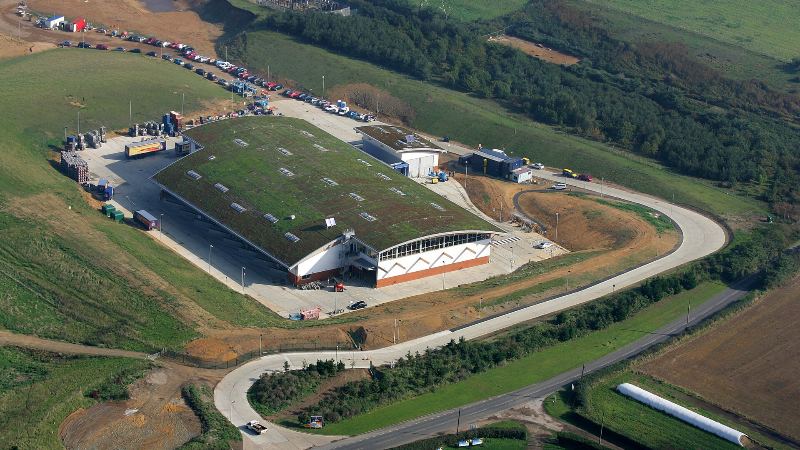
Adnams Distribution Centre, Southwold
Photo: Sky Garden Ltd, CC BY-SA 4.0, Wikimedia Commons
Adnams Distribution Centre
Aukett Fitzroy Robinson · Southwold · 2006

Hempcrete here: hemp-lime block walls under a living roof.

About the building ↗

02Try it on a board

Pick up to three materials to sit beside hempcrete. The board shows the styles that use all of them, and writes a prompt you can take to an image or video generator.

HempcreteRammed Earth
Styles that use all of themSustainable ArchitectureVernacular Architecture
Setting
Scale
Light
Camera
Output

A house, on a dense urban street. Materials: hempcrete that reads as carbon-negative ambition, rammed earth that reads as near-zero impact. Golden hour, warm raking light. Eye level from across the street, 35mm. Architectural photograph, medium format, no people, no text.

03The styles built on it

Sustainable ArchitectureVernacular Architecture

04Questions

Which design styles use hempcrete?

Sustainable Architecture and Vernacular Architecture.

What goes well with hempcrete?

Hempcrete pairs well with clay plaster, reclaimed timber and living roof substrate.

What does hempcrete communicate?

Carbon-negative ambition, Breathable comfort and Bio-material honesty. It suits regenerative architecture, passive builds and sustainable retrofits.

What is the carbon footprint of hempcrete?

Hempcrete stores more carbon than making it releases, about 0.1 kg of CO₂ per kilo: hemp stores more carbon than the lime binder releases.

05More earth

Rammed EarthClay PlasterLiving Roof Substrate
Every materialOpen the materials sampler →
MarbleLimestoneGraniteTravertineBasaltSandstoneSlateStructural SteelCor-Ten SteelTitaniumCopperWrought IronAnodized AluminumChromeBronzeZinc CladdingCast IronPlate GlassGlass BlockLeaded Art GlassStructural GlassETFE MembraneElectrochromic GlazingOakTeakBambooCedarCLTReclaimed TimberBirch PlywoodPineFired BrickTerracotta TileAdobe BrickCeramic MosaicGlazed FaïenceRoman BrickPolychrome BrickRammed EarthHempcreteClay PlasterLiving Roof SubstrateExposed ConcreteBoard-Formed ConcretePolished ConcretePrecast Concrete PanelGlass-Fibre Reinforced ConcreteSprayed ConcreteFibreglass ShellCarbon Fibre CompositeAluminium Composite PanelTensile FabricPerforated Steel ScreenPolycarbonateVitrolitePorcelain Enamel Panel