Registrar's index cards on the platen glass - captured by the scanner
1970s-present · Global, with early centers in Northern Europe and the US
Sustainable architecture began as a countercultural response to the energy crisis. The oil embargo of 1973 forced architects to rediscover what vernacular builders had always known: orientation, thermal mass, natural ventilation, and shading could keep buildings comfortable without mechanical systems. The first generation of solar houses, earth-sheltered buildings, and passively cooled structures in the 1970s was experimental and often crude, but it established principles that would become mainstream within decades.
The second wave came through certification systems and policy. BREEAM (UK, 1990), LEED (US, 1998), and the Passivhaus standard (Germany, 1990s) provided measurable criteria for sustainable performance. Architecture firms could no longer claim sustainability through intention alone; buildings had to prove their performance through energy modeling, post-occupancy evaluation, and certifiable metrics. Norman Foster, Renzo Piano, and Ken Yeang were early adopters who demonstrated that sustainable buildings could also be architecturally ambitious.
The current generation has shifted focus from operational energy (heating, cooling, lighting) to embodied carbon (the emissions from manufacturing and transporting building materials). Mass timber construction, pioneered in Austria and Scandinavia, offers structural alternatives to carbon-intensive steel and concrete. Living building standards require net-positive energy and water performance. The question has moved from 'how do we reduce harm?' to 'how do buildings become regenerative elements of their ecosystems?'
The visual DNA: what makes it recognisable
- Clean humanist sans-serifs: Avenir, Proxima Nova, Source Sans
- Green-coded visual identity systems
- Infographic-oriented type for performance data communication
- Accessible, readable type choices reflecting democratic values
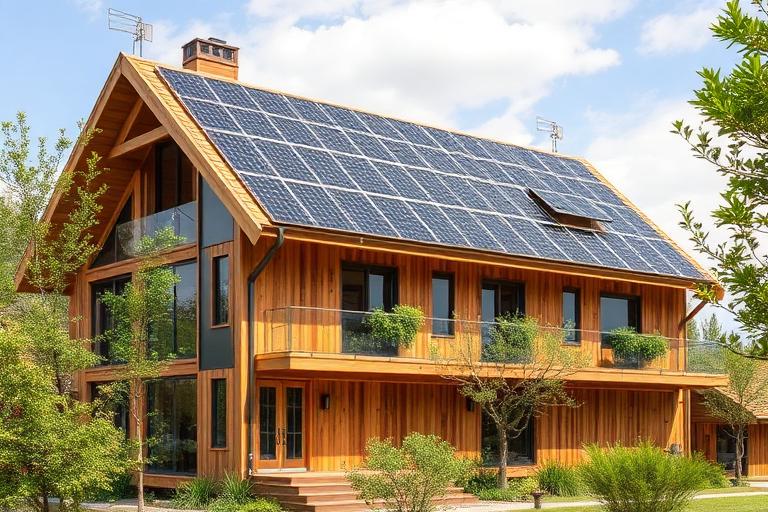
- Building orientation optimized for solar gain and shading
- Cross-ventilation strategies driving plan organization
- Atria and light wells reducing artificial lighting dependency
- Compact plans minimizing envelope-to-floor-area ratios
- Mass timber (CLT, glulam): #C4A87C, #B89468, #A08050
- Rammed earth and unfired clay: #B89878, #A08868, #C8A888
- Recycled and reclaimed materials: variable patina
- Green roof and living wall vegetation: #5C7C4C, #4C6C3C
- Photovoltaic panels integrated into facade or roof design
- Green roofs and planted terraces
- External shading devices responsive to sun angle
- Rainwater collection systems made visible as design features
8-channel console - dominant channels taped & circled by the registrar
Your aesthetic passport - share the fingerprint
The style's primary materials, assembled bottom-up
Tap a stratum for material detail · Full catalog
Future-Facing · 1990–present - tap any style to travel
4 color interpretations of this aesthetic
Join waitlist for access
Join the waitlist for full access
Join the waitlistSustainable Architecture: where the language earns its place
Sustainable Architecture is most effective when its visual decisions do useful work. Architecture as ecological act - passive solar section, cross-ventilated plan, mass timber carbon lock, living roof hydrology, and the discipline of measuring every decision against planetary budget rather than aesthetic preference.
The style gives styling, proportion, and image sequencing a clear point of view rather than treating them as decoration.
It can turn atmosphere, material, and spatial pacing into evidence of a distinct experience before a visitor arrives.
It helps a physical or editorial environment feel authored, which raises attention and perceived care.
They recognize the references, proportion, and restraint that make the language feel intentional.
They respond to visible judgment because it reduces the feeling of interchangeable product.
A coherent aesthetic gives them a usable standard for choosing images, objects, and collaborators.
The cost comes from consistent art direction, suitable locations or materials, and time to edit the details that would otherwise undermine the premise.
The challenge is conceptual. It takes visual literacy and a real point of view to avoid borrowing surface cues without their original logic.
Lighting, casting, type, color, material, and retouching must agree. A single weak choice can make the work feel like an imitation.
Sustainable Architecture creates its strongest advantage when it gives a brand a standard of judgment, not merely an attractive finish. It fails when recognizable cues are collected without a governing idea. The difference between average and exceptional execution is usually proportion: how much is shown, what is withheld, and whether every element belongs to the same world. The most capable teams pair an exacting art director with specialists who understand the medium, from photographer and stylist to set designer, editor, and typographer.
Should Sustainable Architecture be the strategic choice?
Surface imitation is easy. The language becomes generic when familiar cues replace proportion, specificity, and a coherent system.
Its visual ingredients appear regularly in contemporary work, but a rigorous execution remains distinguishable from a loose collection of references.
Its strongest principles depend on composition, material, and cultural literacy rather than a short-lived visual effect.
It asks for consistency across photography, typography, motion, environments, and the many details that make a brand feel believable.
Sustainable Architecture deserves serious consideration from brands and institutions that can articulate a real point of view and protect it through execution. It is less suitable for work that needs immediate instructional clarity, broad visual neutrality, or low-cost production flexibility. Its greatest advantage is differentiation through judgment: it can make a product, place, or editorial proposition feel authored rather than merely packaged. Average executions borrow recognizable signals, then lose coherence when type, casting, copy, or materials fail to agree. Exceptional executions understand the visual language as a system of choices, including what not to show. The largest mistake is treating the style as a finish applied after strategy. Adopt it only when the product and organization can carry the same standard of care the imagery proposes.
Join waitlist for access
Join the waitlist for editorial depth
Join the waitlistConnected across the creative knowledge graph