ReadingsIn use 700 BCE to now
WeightVery heavy
WarmthIn between
CostExpensive
PermanenceLasts centuries
PrecisionMachine-precise
CarbonModerate
Making one kilo releases about 0.5 kg of CO₂: quarrying and cutting are modest; transport is most of it.
It saysLuxuryComposureTimelessness
Best for: Luxury hospitality, Beauty, Residential.
01The building that proves it
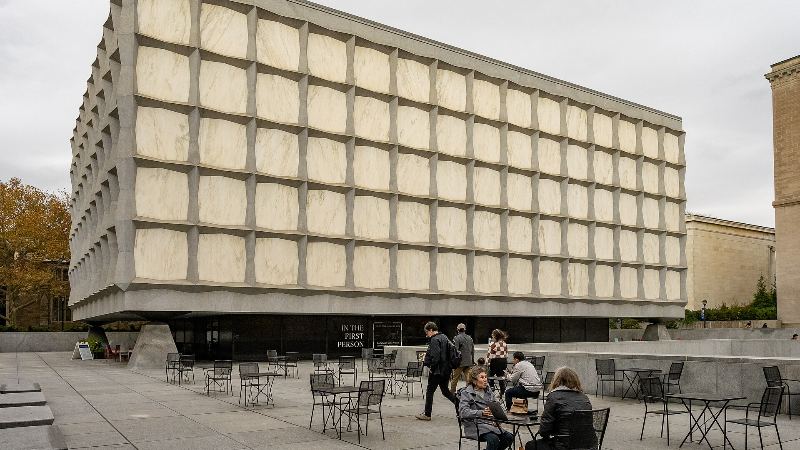
Beinecke Rare Book & Manuscript Library
Gordon Bunshaft, SOM · New Haven · 1963
Marble here: translucent Vermont marble panels that glow amber from inside.
About the building ↗02Try it on a board
Pick up to three materials to sit beside marble. The board shows the styles that use all of them, and writes a prompt you can take to an image or video generator.
Styles that use all of themArt Deco ArchitectureBiophilic DesignClassical ArchitectureMediterranean ArchitectureSoft Minimalism
03The styles built on it
Classical ArchitectureNeoclassical ArchitectureArt Deco ArchitectureStripped ClassicismMediterranean ArchitectureBiophilic DesignSoft Minimalism
Also in these styles, in their own words
- Sculpture"Marble white: #F2EFEB: the idealized sculpture material and its warm translucency"
- Vaporwave"Marble texture: white Carrara marble used on digital objects"
- Art Deco"Marble, lacquer, and exotic veneers as surface textures"
- Architectural Postmodernism"Polished granite and marble veneers: #C8B8A0, #E8D8C8"
- International Style"Polished stone lobbies: marble, granite, travertine"
- Neoclassical"Marble white: #F5F2EE, #EDE8E0: pure Carrara marble and its warm undertone"
- Hollywood Regency"Lacquered wood, mirror, brass, velvet, silk, marble and plaster"
- Radical Italian Design"Laminate printed with a grid or a marble"
04Questions
Which design styles use marble?
Classical Architecture, Neoclassical Architecture, Art Deco Architecture, Stripped Classicism and Mediterranean Architecture, and 10 more.
What goes well with marble?
Marble pairs well with bronze, oak and plate glass.
What does marble communicate?
Luxury, Composure and Timelessness. It suits luxury hospitality, beauty and residential.
What is the carbon footprint of marble?
Making one kilo of marble releases about 0.5 kg of CO₂, cradle to gate: quarrying and cutting are modest; transport is most of it.
05More stone
Every materialOpen the materials sampler →
MarbleLimestoneGraniteTravertineBasaltSandstoneSlateStructural SteelCor-Ten SteelTitaniumCopperWrought IronAnodized AluminumChromeBronzeZinc CladdingCast IronPlate GlassGlass BlockLeaded Art GlassStructural GlassETFE MembraneElectrochromic GlazingOakTeakBambooCedarCLTReclaimed TimberBirch PlywoodPineFired BrickTerracotta TileAdobe BrickCeramic MosaicGlazed FaïenceRoman BrickPolychrome BrickRammed EarthHempcreteClay PlasterLiving Roof SubstrateExposed ConcreteBoard-Formed ConcretePolished ConcretePrecast Concrete PanelGlass-Fibre Reinforced ConcreteSprayed ConcreteFibreglass ShellCarbon Fibre CompositeAluminium Composite PanelTensile FabricPerforated Steel ScreenPolycarbonateVitrolitePorcelain Enamel Panel