Registrar's index cards on the platen glass - captured by the scanner
Ancient to present · Mediterranean Basin: Southern Europe, North Africa, Eastern Mediterranean
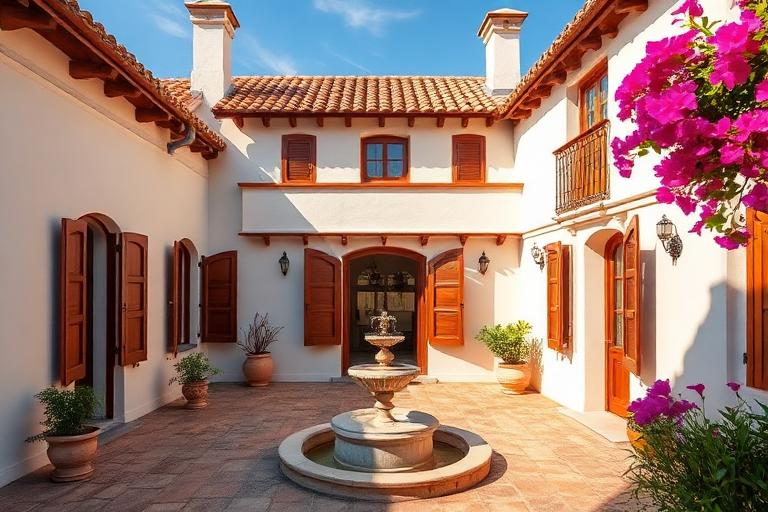
Mediterranean architecture is not a single style but a family of building traditions sharing a response to the same climate: hot, dry summers, mild winters, intense sunlight, and seasonal rainfall. From the Cycladic islands to the North African coast to the Spanish Andalusia, builders developed overlapping strategies: thick masonry walls for thermal mass, whitewashed surfaces reflecting solar radiation, small windows on sun-facing facades, courtyards for ventilation and shade, and flat or low-pitched tile roofs for water collection.
The traditions vary by subregion. Greek island architecture (Santorini, Mykonos) uses whitewashed cubic volumes with blue accents, creating villages that read as abstract sculptures against volcanic landscapes. Moroccan architecture organizes around the riad (courtyard house) with minimal external expression but richly decorated interiors with zellige tile and carved plaster. Spanish colonial architecture exported Mediterranean principles to Latin America, where they merged with indigenous building traditions.
Contemporary Mediterranean architecture ranges from literal revival (the tile-roofed, stuccoed villa remains the default luxury housing type across Southern Europe and California) to critical reinterpretation. Ricardo Bofill's work in Barcelona, Alvaro Siza's in Portugal, and Rafael Moneo's in Spain all engage with Mediterranean light, material, and spatial traditions through modern formal languages. The rising importance of passive cooling strategies in a warming world makes Mediterranean building knowledge increasingly relevant globally.
The visual DNA: what makes it recognisable
- Classical and humanist serifs: Centaur, Jenson, Palatino
- Warm, rounded sans-serifs: Avenir, Circular, Brown
- Tile-painted and hand-lettered signage traditions
- Inscriptional capitals for institutional buildings
- Courtyard plans organizing rooms around a central open space
- Thick walls with deep-set windows creating shade and thermal mass
- Loggias, arcades, and covered terraces as transitional spaces
- Organic village layouts following hillside contours
- Whitewashed stucco and lime plaster: #FFFFFF, #F5F0E8, #EEECE8
- Terracotta roof tiles and flooring: #C87050, #B86040, #D88060
- Natural stone (limestone, sandstone, volcanic): #D8CCA8, #C8BC98
- Blue accents (Greek tradition): #2255AA, #3366BB, #4477CC
- Terracotta-tiled roofs (hip, gable, or barrel vault)
- Arched openings and colonnaded walkways
- Courtyard gardens with water features and citrus trees
- Iron balconies and wrought-iron window grilles
8-channel console - dominant channels taped & circled by the registrar
Your aesthetic passport - share the fingerprint
The style's primary materials, assembled bottom-up
Tap a stratum for material detail · Full catalog
Vernacular · 1700–present - tap any style to travel
4 color interpretations of this aesthetic
Join waitlist for access
Join the waitlist for full access
Join the waitlistMediterranean Architecture: where the language earns its place
Mediterranean Architecture is most effective when its visual decisions do useful work. The sun-logic of three thousand years - Cycladic cubes on volcanic caldera, Moroccan riad courtyard cooling, and the Alhambra's geometric water gardens as the mathematical definition of paradise: thick walls, deep shadow, water at the center.
The style gives styling, proportion, and image sequencing a clear point of view rather than treating them as decoration.
It can turn atmosphere, material, and spatial pacing into evidence of a distinct experience before a visitor arrives.
It helps a physical or editorial environment feel authored, which raises attention and perceived care.
They recognize the references, proportion, and restraint that make the language feel intentional.
They respond to visible judgment because it reduces the feeling of interchangeable product.
A coherent aesthetic gives them a usable standard for choosing images, objects, and collaborators.
The cost comes from consistent art direction, suitable locations or materials, and time to edit the details that would otherwise undermine the premise.
The challenge is conceptual. It takes visual literacy and a real point of view to avoid borrowing surface cues without their original logic.
Lighting, casting, type, color, material, and retouching must agree. A single weak choice can make the work feel like an imitation.
Mediterranean Architecture creates its strongest advantage when it gives a brand a standard of judgment, not merely an attractive finish. It fails when recognizable cues are collected without a governing idea. The difference between average and exceptional execution is usually proportion: how much is shown, what is withheld, and whether every element belongs to the same world. The most capable teams pair an exacting art director with specialists who understand the medium, from photographer and stylist to set designer, editor, and typographer.
Should Mediterranean Architecture be the strategic choice?
Surface imitation is easy. The language becomes generic when familiar cues replace proportion, specificity, and a coherent system.
Its visual ingredients appear regularly in contemporary work, but a rigorous execution remains distinguishable from a loose collection of references.
Its strongest principles depend on composition, material, and cultural literacy rather than a short-lived visual effect.
It asks for consistency across photography, typography, motion, environments, and the many details that make a brand feel believable.
Mediterranean Architecture deserves serious consideration from brands and institutions that can articulate a real point of view and protect it through execution. It is less suitable for work that needs immediate instructional clarity, broad visual neutrality, or low-cost production flexibility. Its greatest advantage is differentiation through judgment: it can make a product, place, or editorial proposition feel authored rather than merely packaged. Average executions borrow recognizable signals, then lose coherence when type, casting, copy, or materials fail to agree. Exceptional executions understand the visual language as a system of choices, including what not to show. The largest mistake is treating the style as a finish applied after strategy. Adopt it only when the product and organization can carry the same standard of care the imagery proposes.
Join waitlist for access
Join the waitlist for editorial depth
Join the waitlistConnected across the creative knowledge graph