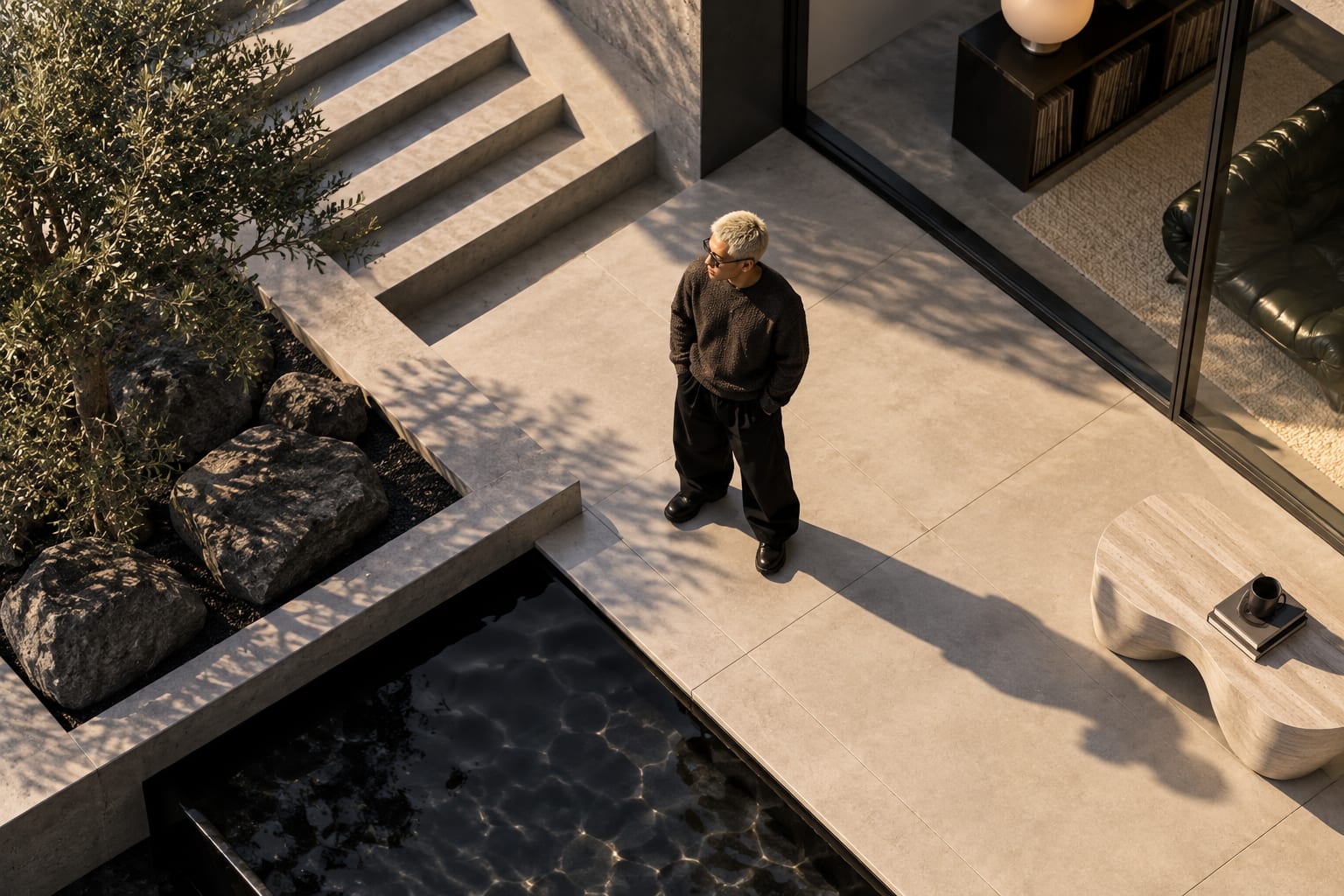
Isometric is not a place a camera can stand; it is a way of drawing space. It comes from technical illustration and video games, and it has become a visual language of its own for explaining systems, rooms, cities and products because it shows three faces of everything at once without perspective ever distorting a single measurement. In generative work it is the most consistently interpreted camera word there is.
Try it
Move the strength and the camera moves. Change the lens and the field of view changes. Pick a subject and the direction is written for it.
0% · High oblique photograph. Camera high at a corner, about 35 degrees down, 45 degrees to the axes, with normal perspective still converging.
40% · Long-lens approximation. Same elevation and rotation from far away with a long lens; convergence nearly gone, faces nearly parallel.
70% · Isometric. True parallel projection: edges parallel, no vanishing point, three faces of every object visible, sizes constant with distance.
100% · Strict isometric diorama. Parallel projection on a 30-degree grid, the scene as a floating diorama on a flat field, consistent light from the upper left, every element aligned to the three axes.
The physical relationship between lens and subject, before any lens or light is chosen.
- Height
- Elevated, conceptually about 35 degrees above the ground plane, at the corner of the scene.
- Vertical angle
- About 35 degrees down, held constant across the whole scene.
- Horizontal angle
- 45 degrees to the scene's main axes, so two vertical faces are seen equally.
- Relationship
- Diorama. The viewer looks into a model from above its corner.
- Distance
- None. In parallel projection distance does not change size, which is the whole point.
Perspective, depth, scale and distortion: what changes in the picture when the camera is here.
- Perspective
- None. Parallel lines stay parallel; there is no vanishing point.
- Depth
- Read only through overlap and position on the page, never through scale.
- Scale
- Constant. A near object and a far one of the same size are drawn the same size.
- Distortion
- None in the usual sense, but the eye reads a slight unreality because the world does converge and this does not.
- Spatial feeling
- Model-like, diagrammatic, clean. A toy world.
What it tends to communicate
Tendencies, not laws. What the geometry usually reads as, and where that reading breaks.
Isometric reads as friendly and explanatory in illustration, as nostalgic in games, and as cold when applied to a real photograph. It is a style as much as a view, and the style carries its own associations.
Use it for
- Explaining systems, processes and floor plans
- Product families and exploded views
- Cities, campuses and maps
- Game and app illustration
- Room and interior concepts
- Icons and infographics
Less suited to
- Portraits
- Emotion and atmosphere
- Photorealism, where the lack of convergence reads as wrong
- Anything that needs the viewer inside the space
It says
The same camera position asks for different things from a face, a shoe, a facade and a car.
As figures in a scene, small and stylised. Isometric people are population, not portraits.
Prompt phrasing
isometric scene with small stylised figures as part of the environment, parallel projection
The decisions that sit on top of the camera position and change what it produces.
How the lens changes it
Recommended: Telephoto. Isometric scenes are whole worlds or whole objects; tight isometric crops lose the projection's meaning.
- Ultra-wide · 14 to 20mm
- The opposite of isometric. Convergence at its strongest.
- Wide · 24 to 35mm
- Strong convergence; not isometric.
- Normal · 40 to 60mm
- Still converges. A photograph can only approximate isometric from far away.
- Telephoto · 85 to 200mm
- A very long lens from a great distance at 35 degrees elevation approaches parallel projection; tilt-shift architectural work gets closest.
Composition
Which compositions this camera position rewards, and why the pairing works.
- Subject placement
- On a diamond or hexagonal grid; the scene tiles.
- Horizon
- None. The ground plane is a diamond and the frame edges are the only bounds.
- Foreground
- Objects nearer the bottom corner overlap those behind; that overlap is the only depth cue.
- Background
- Usually a flat field or nothing. The scene floats.
- Negative space
- Around the diorama. Isometric scenes are islands in empty space.
- Geometry
- Three axes at 120 degrees. Cubes, hexagons, diamonds.
Light
- Consistent directional light, usually from the upper left, so the three faces read as light, mid and dark.
- Soft ambient shadows keep the diorama clean; hard cast shadows fight the flatness.
- No atmospheric perspective; distance should not fade.
Motion
Isometric scenes scroll rather than dolly; an orbit in 90-degree steps rotates the diorama.
A view is where the camera is. A movement is where it goes. They combine.
Read from the shot lists in each style's photo brief, not assigned by hand. A style is here because its own brief asks for this camera.
No style's photo brief names this view yet. When one does, it will appear here on its own; nothing is assigned by hand.
The failures that make this camera position read as an accident rather than a decision.
- Isometric with a vanishing point, which is just a high angle and reads as a mistake.
- Mixed projection: some objects converging, some not.
- Applying it to subjects that need emotion or atmosphere.
- Inconsistent light direction across the faces, which breaks the three-tone reading.
Negative guidance for a model
Prompt language
Geometry, not labels. Models read camera words inconsistently; they read positions the same way every time.
Nearby views



Contrast with
The opposite decisions. If this view is wrong for the picture, one of these is usually right.


In the knowledge graph
Questions
Can a real camera take an isometric photograph?
Not exactly. Isometric is parallel projection, and every lens converges. A very long lens from a great distance at about 35 degrees elevation gets close, and tilt-shift architectural photography gets closer, but true isometric is rendered or drawn.
What is the difference between isometric and axonometric?
Axonometric is the family of parallel projections; isometric is the member where all three axes are foreshortened equally, at 120 degrees to each other on the page. Dimetric and trimetric foreshorten the axes differently. In everyday design language, isometric is used for all of them.
Why does AI handle isometric so well?
Because it is a style as much as a view, with a huge body of consistent illustration and game art behind it. The word is unambiguous in a way that low angle or Dutch tilt are not. Still ask for parallel projection and no vanishing point, or the model may add convergence.