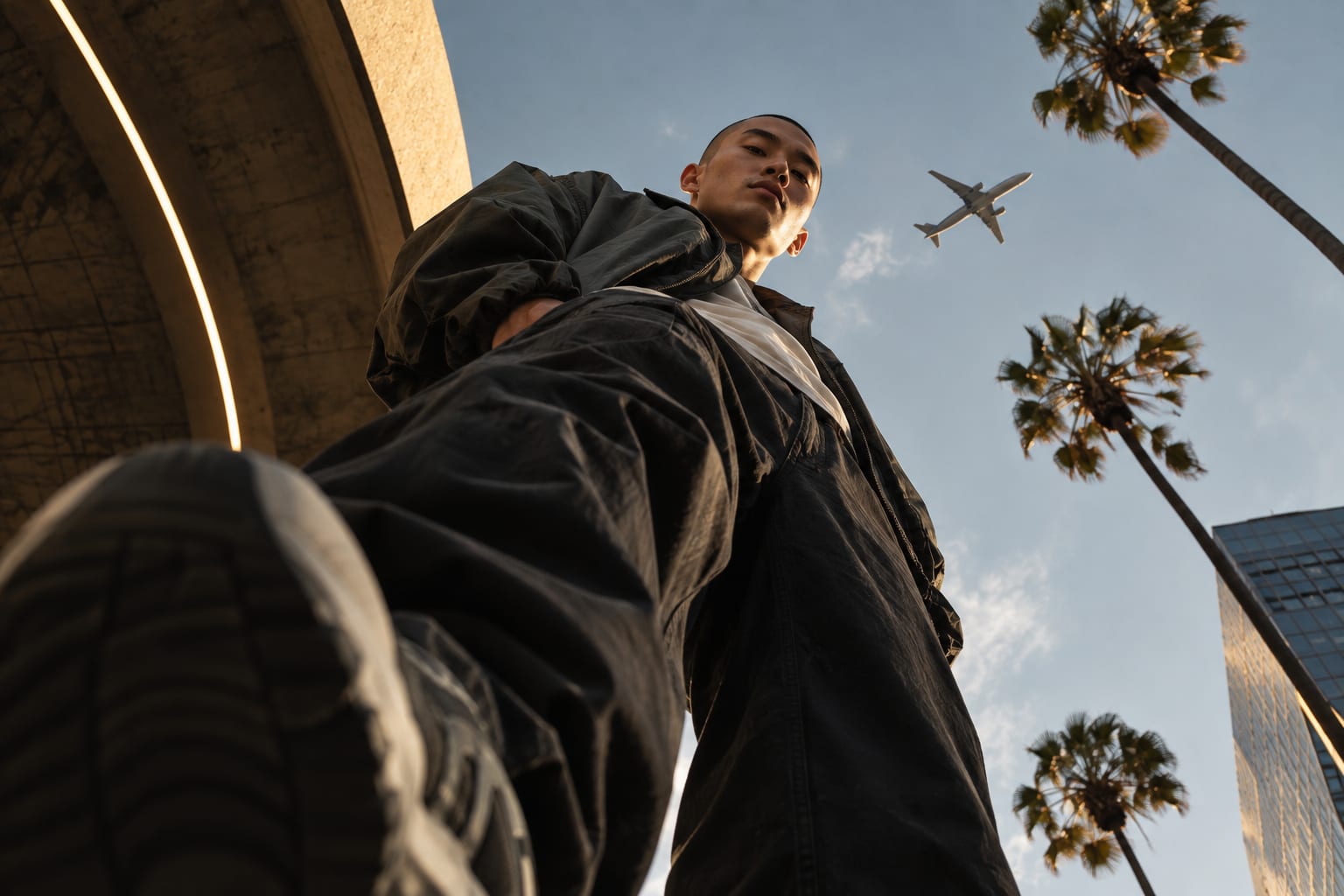
Underneath is the overhead's mirror: a plan view from the wrong side. It shows the surface nobody looks at, the soles, the undersides, the ceiling of a canopy, and because the viewer is under the subject it turns even a small thing into something that could fall on them. Used well it is vertiginous and strange; used carelessly it is a nostril shot.
Try it
Move the strength and the camera moves. Change the lens and the field of view changes. Pick a subject and the direction is written for it.
0% · Steep low angle. Camera near the ground tilted up about 70 degrees; the underside begins to show, the ground is out of frame.
40% · Nearly vertical. Camera below the subject tilted up about 80 degrees; the subject rises into the void with strong convergence.
70% · Straight up. Camera directly beneath, pointing straight up; the underside is the subject and the sky or ceiling the background.
100% · Under the base. Camera directly beneath and very close, straight up through glass or water; the underside fills the frame and towers.
The physical relationship between lens and subject, before any lens or light is chosen.
- Height
- Below the subject's base: on the ground, under a glass floor, under water, under a table.
- Vertical angle
- Steeply upward, from about 70 degrees to a full 90.
- Horizontal angle
- Rotation only at a full 90 degrees; otherwise any.
- Relationship
- Beneath. The subject is above the viewer and the viewer is exposed to it.
- Distance
- The underside grows fast with proximity. A glass floor at a metre makes soles huge; a sky at fifty metres keeps a tower's silhouette true.
Perspective, depth, scale and distortion: what changes in the picture when the camera is here.
- Perspective
- Tall objects converge upward to a single point. Everything vertical rushes toward the centre or top of the frame.
- Depth
- Extreme. The base of a tall subject is huge and its top is tiny.
- Scale
- Exaggerated. The subject is enormous because the viewer is under it.
- Distortion
- Strong with wide lenses. Bodies become wedges, buildings become spikes.
- Spatial feeling
- Vertiginous. The ground is gone and the subject looms.
What it tends to communicate
Tendencies, not laws. What the geometry usually reads as, and where that reading breaks.
Awe and unease are the same reading from two moods. A cathedral ceiling from beneath is uplifting; a figure standing over the lens is threatening. What the subject is doing decides.
Use it for
- Ceilings, domes and canopies
- Towers and skyscraper clusters
- Trees and forests
- Sneakers on glass
- Swimmers and divers from below
- Editorial that wants an unexpected angle
Less suited to
- Most portraits
- Product with a plain underside
- Food
- Anything that needs to be seen as a person sees it
It says
The same camera position asks for different things from a face, a shoe, a facade and a car.
Chins, nostrils and the underside of the jaw. Works only with intent: a diver, a dancer, a figure leaping over the lens, or a face looking down into the frame.
Prompt phrasing
worm's-eye view of a figure from directly below, looking up at the underside of the body against the sky
The decisions that sit on top of the camera position and change what it produces.
How the lens changes it
Recommended: Ultra-wide, Wide. Underneath usually wants the whole subject rising into a void. Tight underneath framing is a texture study of an underside.
- Ultra-wide · 14 to 20mm
- The native lens: a whole dome, a whole canopy, a whole tower cluster in one radial frame.
- Wide · 24 to 35mm
- Dramatic convergence with somewhat controlled edges.
- Normal · 40 to 60mm
- A section of ceiling or canopy, flatter and more abstract.
- Telephoto · 85 to 200mm
- A detail of the underside at a distance: a cornice, the tip of a spire against sky.
Composition
Which compositions this camera position rewards, and why the pairing works.
- Subject placement
- Centred for symmetry and vertigo, or off-centre with the void as the counterweight.
- Horizon
- None. The frame is sky, ceiling or void with the subject entering it.
- Foreground
- The underside is the foreground: soles, undercarriage, the base of a column.
- Background
- Sky, ceiling or water surface. Uniform, and therefore graphic.
- Negative space
- The void above the subject dominates. A small subject in a large sky reads as isolation or flight.
- Geometry
- Radial. Converging lines, circular domes, spokes of a canopy.
Light
- The subject is often backlit by the sky or the ceiling light, so silhouette is the default reading.
- Under glass, light the subject from above and the sole from below with a soft panel.
- Interiors: the ceiling fixtures are in the frame, so treat them as part of the composition.
Motion
A slow rotation about the vertical axis turns a dome or canopy into a kaleidoscope without changing the geometry.
A view is where the camera is. A movement is where it goes. They combine.
Read from the shot lists in each style's photo brief, not assigned by hand. A style is here because its own brief asks for this camera.

The failures that make this camera position read as an accident rather than a decision.
- The accidental nostril shot: a face from beneath with nothing else to justify it.
- Almost straight up. Off by ten degrees, the picture reads as a bad low angle rather than an underneath.
- A dull ceiling or an empty grey sky, which is now the entire background.
- Lens flare from ceiling fixtures or the sun, unless it is the point.
Negative guidance for a model
Prompt language
Geometry, not labels. Models read camera words inconsistently; they read positions the same way every time.
Nearby views



Contrast with
The opposite decisions. If this view is wrong for the picture, one of these is usually right.


In the knowledge graph
Questions
What is a worm's-eye view?
A camera on or near the ground pointing steeply or vertically upward, so the subject is seen from its underside against the sky or ceiling. It is the extreme end of the low angle, where the ground leaves the frame entirely and the subject towers over the lens.
How is underneath different from low angle?
Low angle is a raised look upward with the ground still implied and the subject's front still visible. Underneath is the camera beneath the subject looking straight up, so the underside becomes the subject and there is no ground plane. One is an upshot; the other is a plan from below.
What subjects suit an underneath shot?
Anything with a designed underside or a strong vertical form: domes and atriums, tower clusters, forest canopies, sneakers on glass, divers and dancers. It rarely suits ordinary portraits, food or product with a plain base.