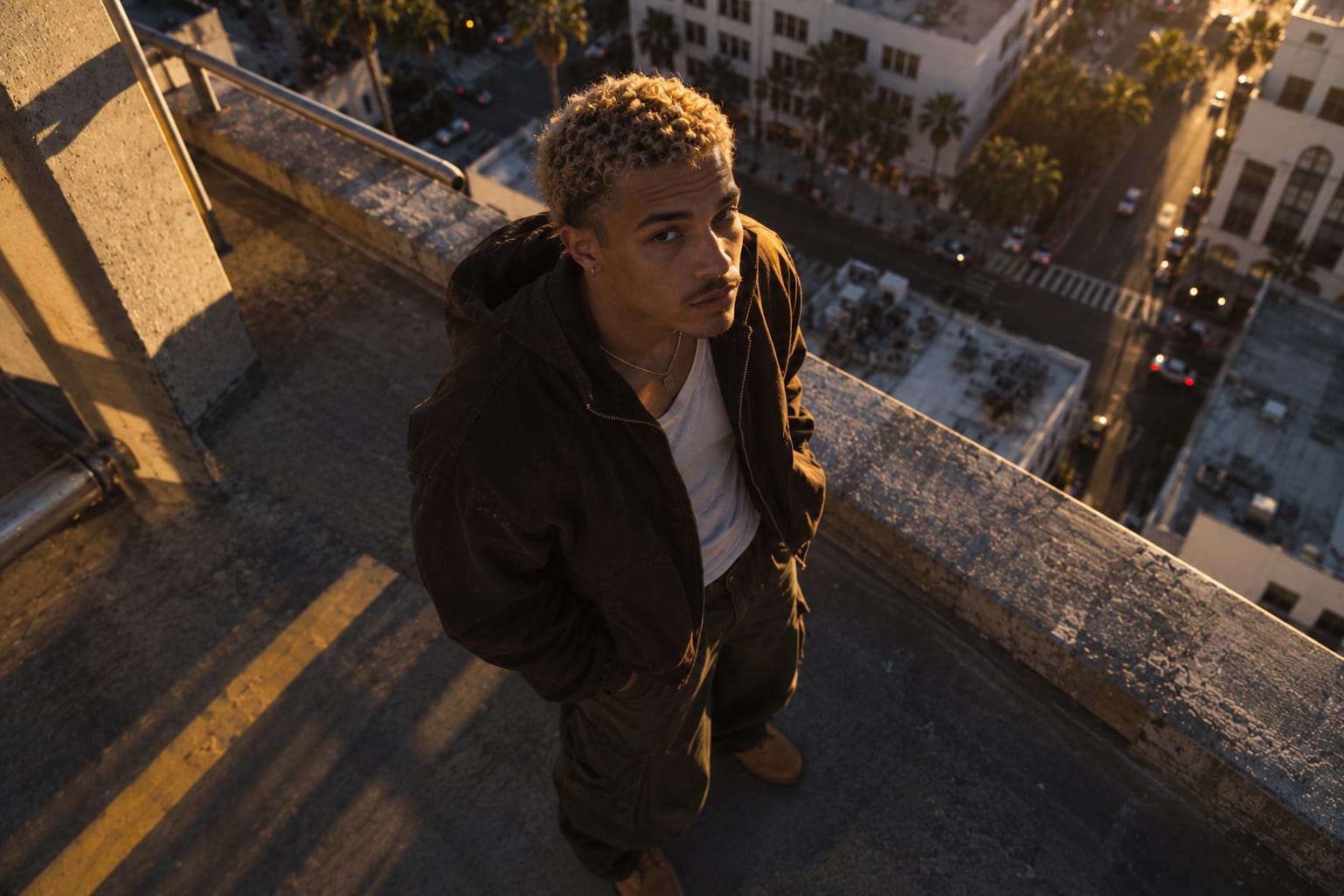
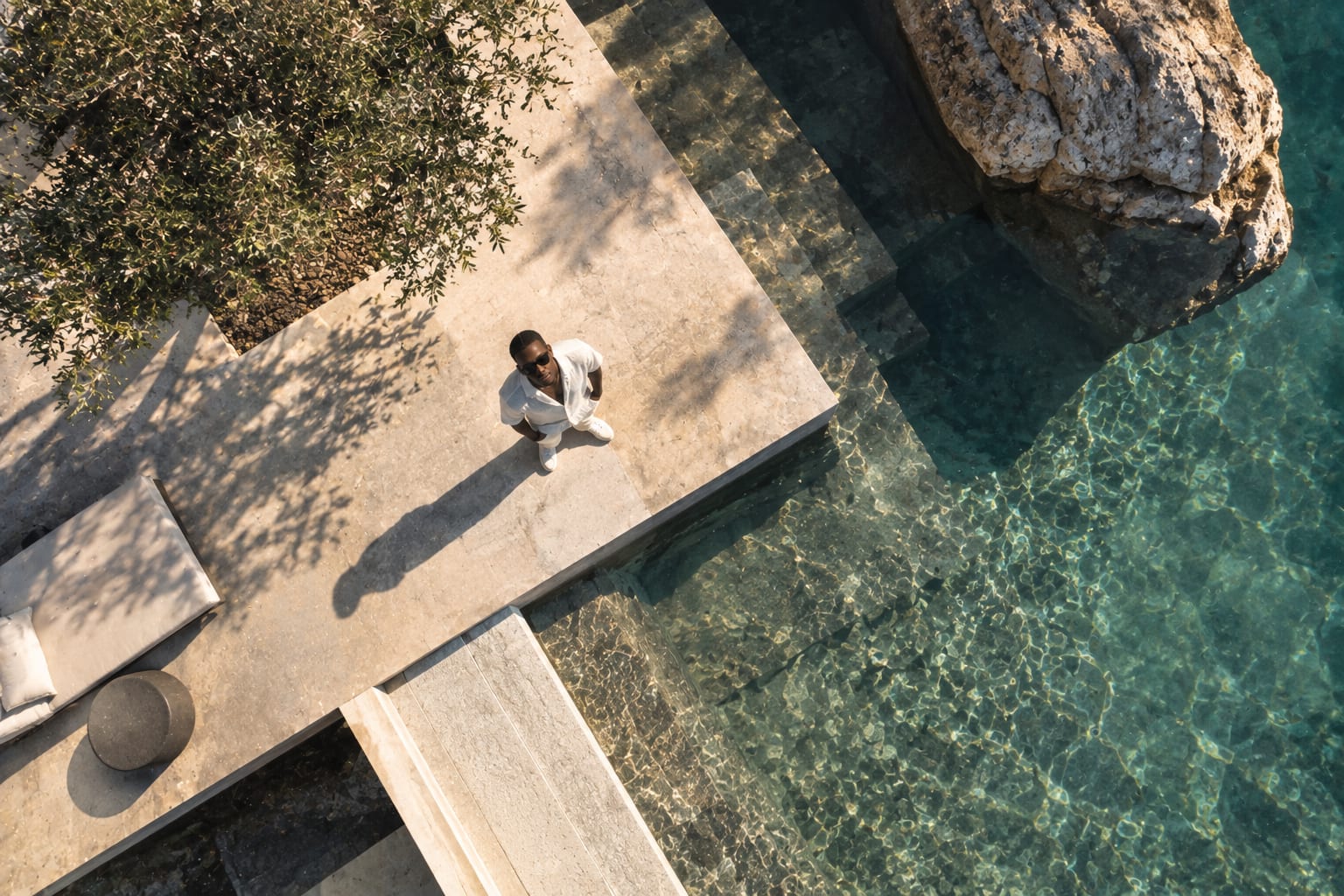
Where the low angle enlarges, the high angle explains. Looking down places the subject in its setting, shows what surrounds it, and gently reduces it, which can read as vulnerability, as tenderness, or simply as overview. It is the angle of maps, of watching, and of care.
Try it
Move the strength and the camera moves. Change the lens and the field of view changes. Pick a subject and the direction is written for it.
0% · Level. Camera at the subject's eye line, no tilt.
20% · Slightly above. Camera a little above the eye line, tilted down a few degrees; eyes look up slightly, ground begins to show.
50% · Clearly above. Camera raised well above the subject, tilted down around 30 to 45 degrees; the ground plane fills the lower half of the frame.
80% · Steep. Camera high above, tilted down around 60 degrees; the subject foreshortens and the horizon leaves the frame.
100% · Extreme, near overhead. Camera far above the subject, tilted nearly straight down; the subject is a figure on a ground plane.
The physical relationship between lens and subject, before any lens or light is chosen.
- Height
- Above the subject's eye line or top surface. A step-ladder is mild; a balcony is pronounced.
- Vertical angle
- Tilted down, from a few degrees to steep. Past about 70 degrees it becomes overhead.
- Horizontal angle
- Any. High frontal angles are gentle; high oblique angles show more of the setting.
- Relationship
- Superior. The viewer looks down on the subject.
- Distance
- Close and high makes the head large and the body small. Far and high turns the subject into a figure in a landscape.
Perspective, depth, scale and distortion: what changes in the picture when the camera is here.
- Perspective
- Verticals converge downward. The ground plane opens up and becomes a large part of the frame.
- Depth
- Strong. The ground recedes as a visible plane, so distance is measurable.
- Scale
- Reduced. The subject looks smaller and the setting larger.
- Distortion
- Wide lenses enlarge heads and shoulders and shrink feet; the subject foreshortens toward the ground.
- Spatial feeling
- Overview. The viewer is outside and above the scene rather than in it.
What it tends to communicate
Tendencies, not laws. What the geometry usually reads as, and where that reading breaks.
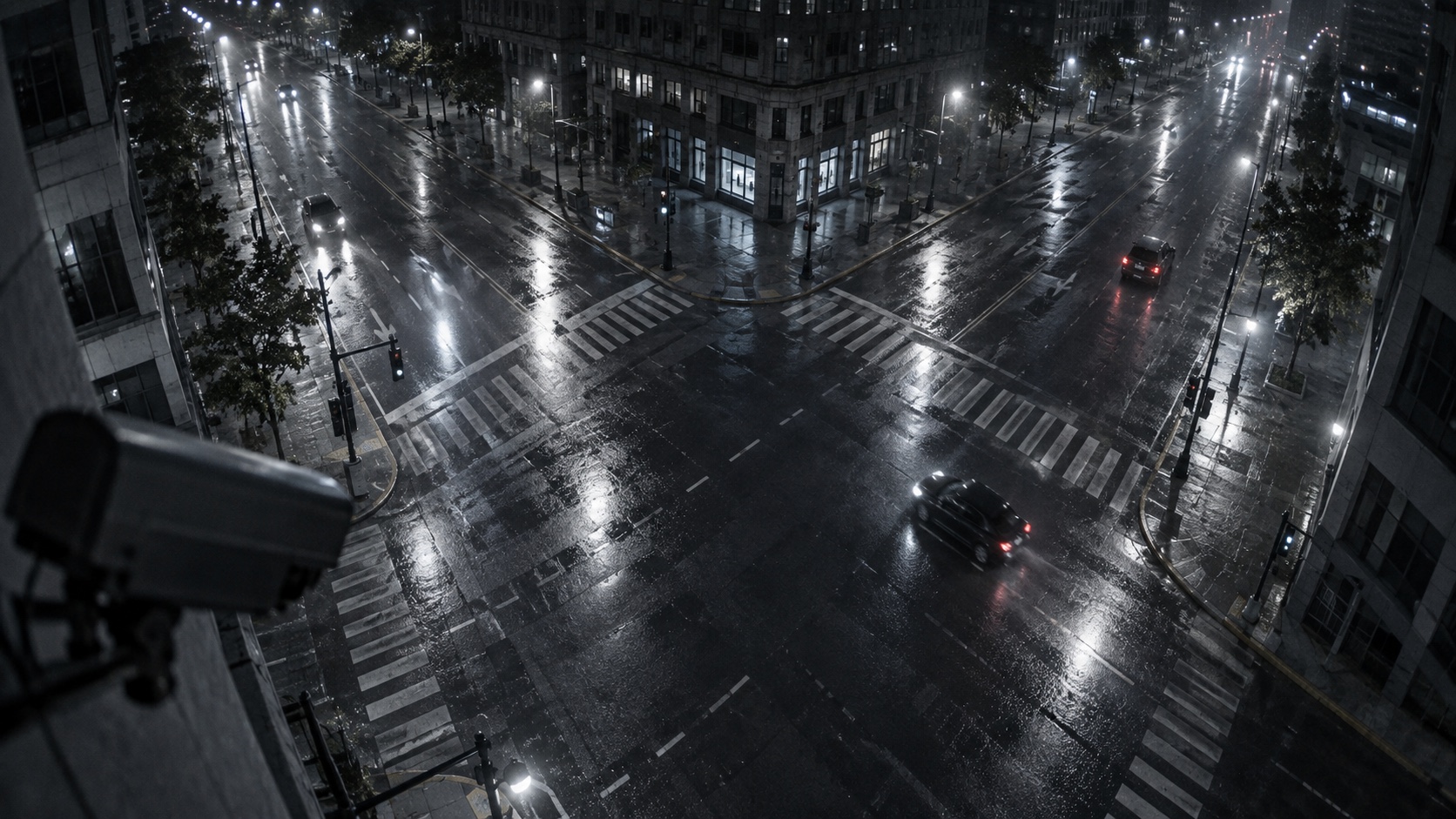
The same downward tilt reads as protective when it is a parent's height over a child and as surveillance when it is a camera's height over a street. Distance and lens decide whether it is care or control.
Use it for
- Establishing a subject in its environment
- Tabletop, desks and workspaces
- Crowds and choreography
- Tender or diminished portraits
- Food on a table from the diner's view
- Interiors that need the floor plan legible
Less suited to
- Monumentality or power
- Hero product shots
- Facades
- Cars, which look like toys from above
It says
The same camera position asks for different things from a face, a shoe, a facade and a car.
Softens and reduces. Eyes look up, the forehead widens, the body shortens. Tender at moderate angles, diminishing at steep ones.
Prompt phrasing
high-angle portrait, camera above the subject looking down, eyes raised toward the lens, softened and reduced
The decisions that sit on top of the camera position and change what it produces.
How the lens changes it
Recommended: Normal, Wide. The high angle wants to include the ground. Tight framing from above is really a downward close-up.
- Ultra-wide · 14 to 20mm
- The ground plane sweeps away dramatically and the subject's head grows; strong for choreography, harsh for portraits.
- Wide · 24 to 35mm
- Shows setting and subject together. The default for environmental high angles.
- Normal · 40 to 60mm
- A gentle downward look with honest proportion. Suits food and tender portraits.
- Telephoto · 85 to 200mm
- From a high distant position, compresses figures onto the ground plane like pieces on a board.
Composition
Which compositions this camera position rewards, and why the pairing works.
- Subject placement
- Anywhere on the ground plane; the plane itself is now a compositional field.
- Horizon
- Rises toward the top of the frame or leaves it. The picture is mostly ground.
- Foreground
- The near ground plane fills the bottom of the frame and can carry texture or pattern.
- Background
- The far ground replaces the sky. Backgrounds are floors, streets, tables and fields.
- Negative space
- Empty floor or ground around a small subject reads as isolation or exposure.
- Geometry
- Receding planes, diagonals of the ground grid, subjects as figures on a field.
Light
- Top light from above the camera lights the ground plane evenly and the subject's top surfaces.
- Low side light rakes across the ground and gives texture to the plane the angle reveals.
- Avoid strong light from behind the camera, which flattens the subject into the floor.
Motion
The crane descending from a high angle to eye level is the cinematic move that says 'now we are inside the story'.
A view is where the camera is. A movement is where it goes. They combine.
Read from the shot lists in each style's photo brief, not assigned by hand. A style is here because its own brief asks for this camera.


The failures that make this camera position read as an accident rather than a decision.
- Accidental diminishment. A high angle on a portrait subject who should look capable makes them look small.
- Enlarged heads and tiny feet from a wide lens close above a person.
- Confusing a steep high angle with overhead; overhead is a plan view with no tilt.
- Cluttered floors. From above, the ground is the background, and it has to be art directed.
Negative guidance for a model
Prompt language
Geometry, not labels. Models read camera words inconsistently; they read positions the same way every time.
Nearby views


Contrast with
The opposite decisions. If this view is wrong for the picture, one of these is usually right.
In the knowledge graph
Questions
What is the difference between high angle and overhead?
High angle is a raised camera tilted down at the subject, usually between 20 and 70 degrees, so the subject still has a visible front and the ground recedes. Overhead is the camera directly above, pointing straight down, so the picture is a plan view with no recession. One is an elevated look; the other is a map.
Does a high angle always make the subject look weak?
No. It reduces the subject's size relative to the setting, which reads as vulnerability in a dramatic scene but as tenderness in a portrait taken at a parent's height, and as simple overview in food and interiors. Distance, lens and the subject's own posture decide the reading.
What is the best angle for food photography?
A moderate high angle around 45 degrees is the restaurant default because it shows the top of the dish and its height at once. Flat dishes such as pizza and spreads suit overhead; tall constructions suit eye level.