Registrar's index cards on the platen glass - captured by the scanner
1995-2010 (peak); ongoing influence · United States and Netherlands, with global adoption
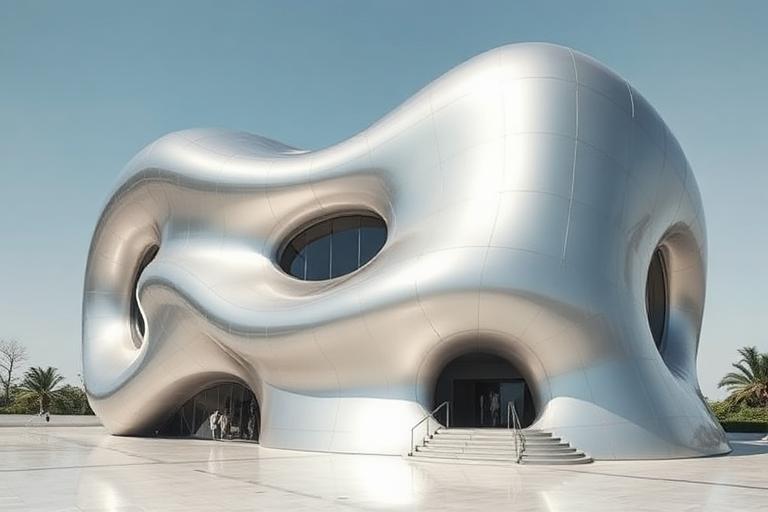
Blobitecture emerged when new software tools (initially animation packages like Maya and Alias, later Rhino and Grasshopper) allowed architects to design and fabricate complex curved forms that had been geometrically impossible to draw or build with traditional methods. Architect Greg Lynn coined the term 'blob' in his 1995 essay 'Blobs, or Why Tectonics is Square and Topology is Groovy,' arguing that smooth, continuous surfaces could respond to site forces more fluidly than the sharp-cornered geometries of conventional architecture.
The first built blobs appeared in the late 1990s and early 2000s. Foreign Office Architects' (FOA) Yokohama International Passenger Terminal (2002) folded the ground plane into a continuous landscape of ramps, decks, and interiors with no clear distinction between floor, wall, and roof. Future Systems' Selfridges department store in Birmingham (2003), wrapped in aluminum discs, became an instant icon. Peter Cook and Colin Fournier's Kunsthaus Graz (2003) sat on the Austrian city's skyline like a blue bioluminescent organism.
Blobitecture faded as a named movement after 2010, partly because its formal tricks became routine and partly because the computational tools that enabled it evolved toward more sophisticated parametric and algorithmic approaches. But its legacy is significant: it permanently demonstrated that architecture need not be rectilinear, and the fabrication techniques developed for blob buildings (CNC-milled molds, doubly curved panels, parametric panelization) became standard tools for contemporary practice.
The visual DNA: what makes it recognisable
- Rounded, soft typefaces: Nunito, Quicksand, Comfortaa
- Organic letterforms with no sharp corners
- Flowing text layouts following curved surfaces
- Futuristic display faces: Eurostile Extended, Orbitron
- No rectilinear grid: forms generated by topological surfaces
- Continuous surfaces folding from floor to wall to roof
- Interior spaces defined by curvature rather than partitions
- Structural systems following doubly curved geometries
- Aluminum and metal cladding panels: #C0C8D0, #B0B8C0, #A0A8B0
- Glass-reinforced concrete (GRC) in white or grey: #E0E0E0, #D0D0D0
- Translucent materials: ETFE, polycarbonate: #E8ECF0, #D8DCE0
- Sprayed concrete and shotcrete: #B0B0B0, #C0C0C0
- Smooth, bulging surfaces without sharp edges
- Building-as-organism metaphors
- Perforated skins with irregular aperture patterns
- Ground plane rising continuously into the building form
8-channel console - dominant channels taped & circled by the registrar
Your aesthetic passport - share the fingerprint
The style's primary materials, assembled bottom-up
Tap a stratum for material detail · Full catalog
Future-Facing · 1995–present - tap any style to travel
4 color interpretations of this aesthetic
Join waitlist for access
Join the waitlist for full access
Join the waitlistBlobitecture: where the language earns its place
Blobitecture is most effective when its visual decisions do useful work. When software freed architects from the right angle - Greg Lynn's embryological housing experiments, FOA's Yokohama International Passenger Terminal as continuous landscape, and NOX's Son-O-House as pure computational biology.
The style gives styling, proportion, and image sequencing a clear point of view rather than treating them as decoration.
It can turn atmosphere, material, and spatial pacing into evidence of a distinct experience before a visitor arrives.
It helps a physical or editorial environment feel authored, which raises attention and perceived care.
They recognize the references, proportion, and restraint that make the language feel intentional.
They respond to visible judgment because it reduces the feeling of interchangeable product.
A coherent aesthetic gives them a usable standard for choosing images, objects, and collaborators.
The cost comes from consistent art direction, suitable locations or materials, and time to edit the details that would otherwise undermine the premise.
The challenge is conceptual. It takes visual literacy and a real point of view to avoid borrowing surface cues without their original logic.
Lighting, casting, type, color, material, and retouching must agree. A single weak choice can make the work feel like an imitation.
Blobitecture creates its strongest advantage when it gives a brand a standard of judgment, not merely an attractive finish. It fails when recognizable cues are collected without a governing idea. The difference between average and exceptional execution is usually proportion: how much is shown, what is withheld, and whether every element belongs to the same world. The most capable teams pair an exacting art director with specialists who understand the medium, from photographer and stylist to set designer, editor, and typographer.
Should Blobitecture be the strategic choice?
Surface imitation is easy. The language becomes generic when familiar cues replace proportion, specificity, and a coherent system.
Its visual ingredients appear regularly in contemporary work, but a rigorous execution remains distinguishable from a loose collection of references.
Its strongest principles depend on composition, material, and cultural literacy rather than a short-lived visual effect.
It asks for consistency across photography, typography, motion, environments, and the many details that make a brand feel believable.
Blobitecture deserves serious consideration from brands and institutions that can articulate a real point of view and protect it through execution. It is less suitable for work that needs immediate instructional clarity, broad visual neutrality, or low-cost production flexibility. Its greatest advantage is differentiation through judgment: it can make a product, place, or editorial proposition feel authored rather than merely packaged. Average executions borrow recognizable signals, then lose coherence when type, casting, copy, or materials fail to agree. Exceptional executions understand the visual language as a system of choices, including what not to show. The largest mistake is treating the style as a finish applied after strategy. Adopt it only when the product and organization can carry the same standard of care the imagery proposes.
Join waitlist for access
Join the waitlist for editorial depth
Join the waitlistConnected across the creative knowledge graph